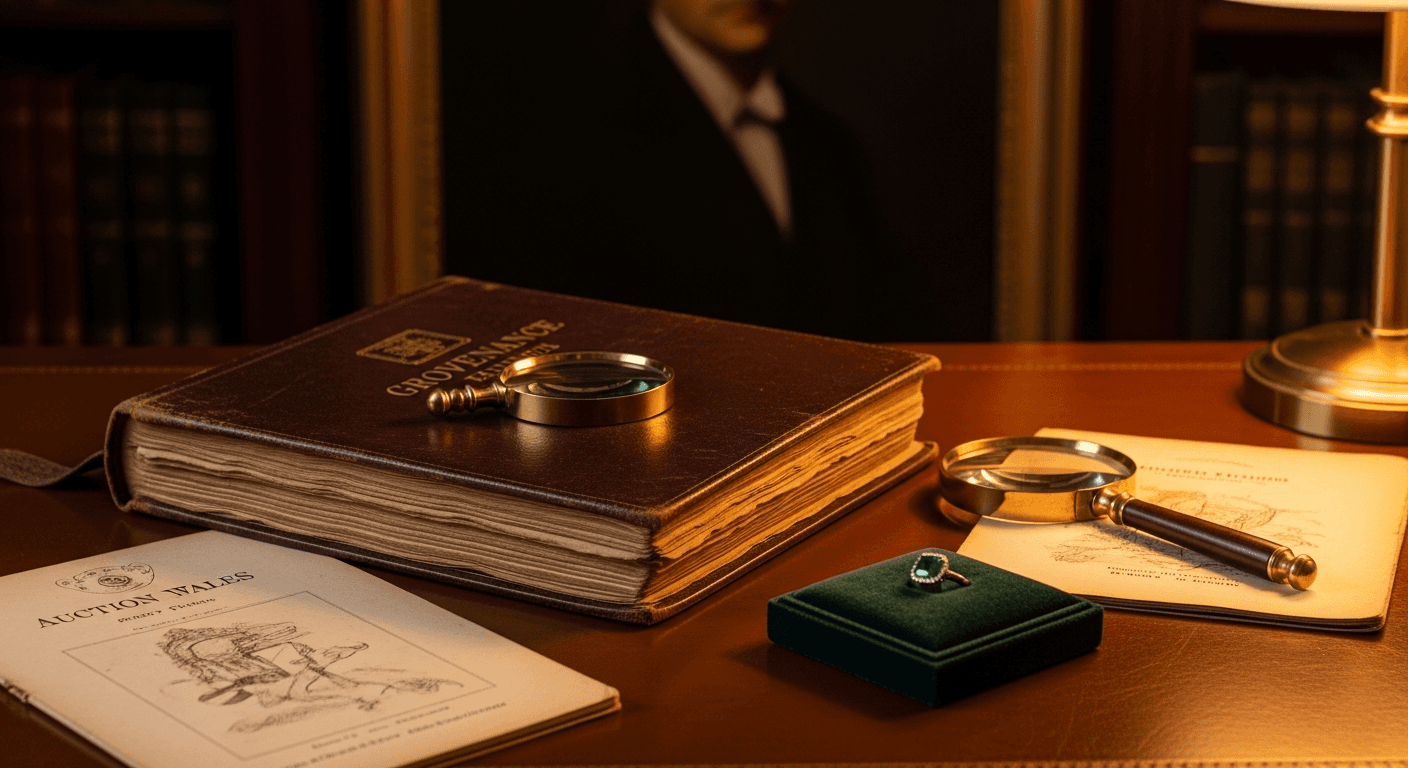
How Provenance Impacts the Long Term Value of Luxury Assets
LuxExclusives Editorial
In the upper tier of the luxury market, ownership history is rarely a footnote. It is one of the defining variables that separates an asset that compounds in value across decades from one that quietly drifts toward the edge of the market. For fine art, rare watches, collectible automobiles, heritage handbags, jewelry, and historically significant real estate, provenance has become inseparable from value itself.
For sophisticated collectors, family offices, and high net worth individuals, provenance now functions less like documentation and more like infrastructure. It establishes legitimacy, authenticates rarity, supports liquidity, and anchors confidence in markets where the difference between a verified piece and an undocumented one can be substantial.
What Does Provenance Actually Mean?
Provenance is the complete record of an asset's life. It traces a piece from creation through every meaningful change of hand, with the documentation to support each transition. For a painting, that may include the artist's studio records, dealer invoices, exhibition catalogues, gallery transfers, and auction history. For a watch, it includes original purchase papers, service records, and any documented chain of custody between owners. For a heritage handbag, it can extend to original receipts, boutique purchase records, and where applicable, archive references from houses like Hermès, whose archives remain some of the most respected institutional memories in luxury.
The thread connecting every category is the same. Provenance is the evidence that an asset is what it claims to be, from whom it claims to come, and where it has been.
Why Does Provenance Influence Long Term Value?
Markets reward certainty. When provenance is well documented, buyers transact with confidence and assets move through the market efficiently. When provenance is incomplete, even genuinely important pieces can face hesitation, discounted offers, or extended time on the market.
Sotheby's and Christie's have spent generations refining the authentication and provenance standards that govern their salerooms, and the most significant auction results almost invariably belong to assets with thoroughly traced histories. The premium paid for a well documented piece is not sentimental. It reflects the reduced risk, the cleaner title, and the greater pool of qualified buyers willing to engage.
The same dynamic shapes private transactions. In off market sales among collectors, family offices, and private clients, the strength of an asset's provenance often determines whether a transaction closes at all.
How Does Documentation Protect Authenticity?
The luxury market has always attracted forgeries, alterations, and misattributions. Authentication is the first line of defense, but documentation is what makes authentication durable.
A properly documented luxury asset typically includes authentication certificates, original purchase records, appraisal history, maintenance and restoration records, exhibition or publication history, and a clear ownership lineage. In categories like fine art, institutional bodies and the FBI Art Crime Team continue to recover stolen and forged works that reach the market through gaps in provenance. In watches, factory archive extracts have become a routine expectation for significant references. In handbags, original receipts, boxes, and authenticity cards materially affect what a piece can command.
Together, these records create something more valuable than any single certificate. They create continuity.
Why Is Provenance Becoming More Important Now?
Three forces are converging.
First, values across the luxury market have risen meaningfully over the last two decades, and with higher values come higher scrutiny. The more an asset is worth, the more buyers, advisors, and underwriters expect a documented history before transacting.
Second, sophisticated owners are increasingly treating tangible luxury assets as part of broader wealth preservation strategy. Fine art, watches, jewelry, handbags, and other collectibles are now discussed alongside private equity, real estate, and traditional financial holdings within family office and private wealth conversations. That repositioning brings with it the same expectations of documentation, valuation visibility, and audit trail that govern the rest of the portfolio.
Third, generational transfer is accelerating. As collections move from one generation to the next, the absence of provenance becomes an operational problem. A piece without a clear record can complicate estate planning, insurance, and eventual sale. A piece with a clean record moves through transfer cleanly.
What Does Poor Provenance Cost an Owner?
The cost is rarely visible until the moment of transaction. Then it becomes immediate.
Assets with incomplete provenance often face slower sales, narrower buyer pools, lower realized prices, and in some cases withdrawal from major auction houses altogether. Insurance underwriting can be more difficult and more expensive. Disputes over authenticity, even when ultimately resolved, can permanently affect a piece's market trajectory.
For collectors holding meaningful positions across multiple categories, the cumulative effect of weak documentation across a collection can be considerable. The market does not forgive gaps in the record. It simply discounts around them.
How Is the Market Adapting?
The infrastructure surrounding luxury ownership is becoming more deliberate. Heritage houses are investing further in archive services. Auction houses continue to refine their authentication standards. Independent specialists, scientific analysis, and digital provenance tools are increasingly part of how the highest tier of the market operates.
At the owner level, the shift is toward centralization. Spreadsheets, paper files, and disconnected appraisals are no longer adequate for collections that span fine art, watches, jewelry, handbags, real estate, and other tangible assets. Sophisticated owners are moving toward systems that consolidate authentication records, valuation tracking, and portfolio visibility within a single discreet environment.
Lux Exclusives was developed for exactly this evolution. Through its private marketplace and Vault ecosystem, members can organize provenance records, authentication documentation, valuation tracking, and portfolio oversight across luxury real estate, fine art, handbags, aviation, yachts, jewelry, and collectibles within a private environment built for intelligent asset stewardship.
It is the kind of infrastructure this category has always needed, and increasingly the kind sophisticated owners expect.
The Direction of Luxury Ownership
Provenance is no longer a supplemental detail. In many cases, it is part of the asset itself, and one of the clearest drivers of long term luxury value.
The collections that compound across generations will be the ones documented with care. Authenticated, traceable, and preserved within infrastructure designed for the way luxury ownership is evolving rather than the way it once was.
That, increasingly, is the future of luxury ownership.
Explore the future of private luxury asset ownership at luxexclusives.com.

© 2025 Lux Exclusives All Rights Reserved