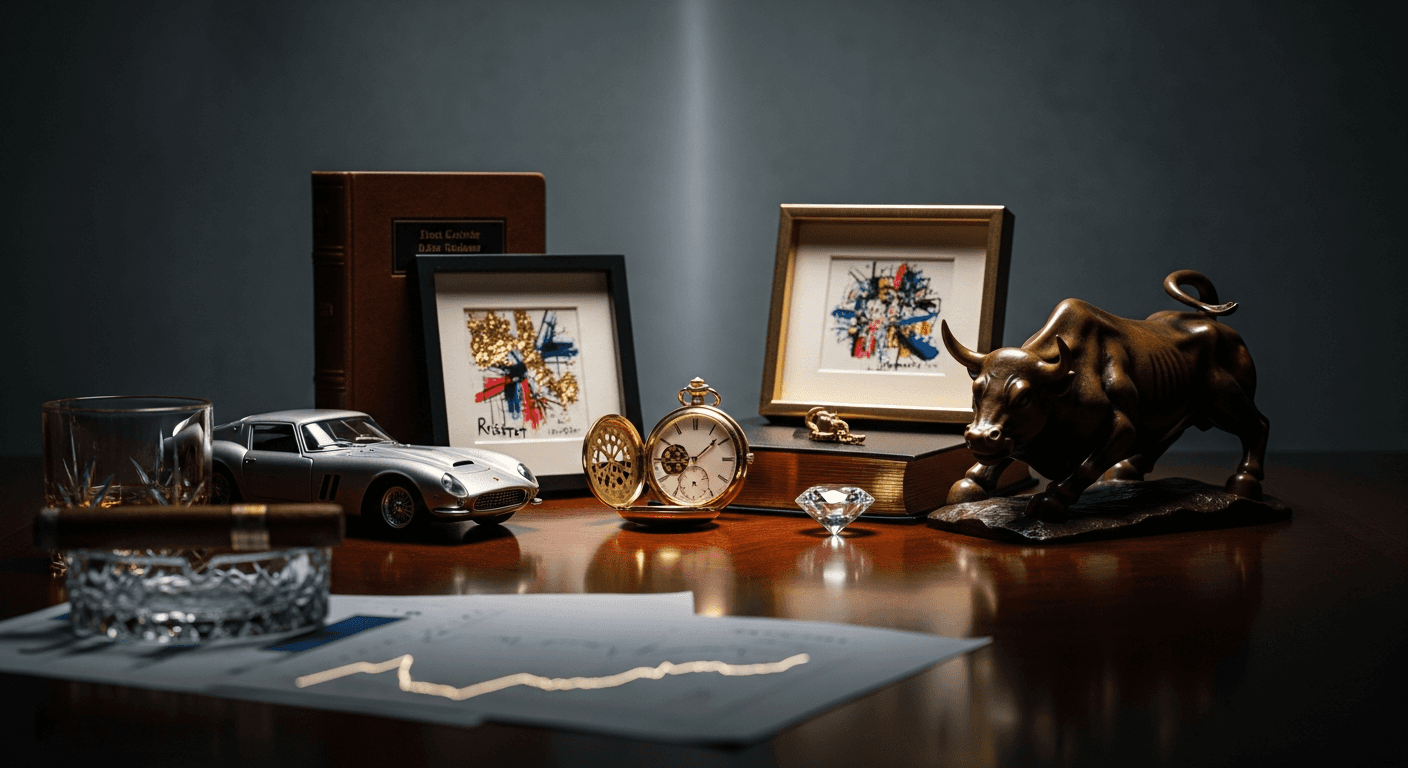
The State of Tangible Assets in 2026: Market Trends for UHNW Investors
LuxExclusives Editorial
The conversation among ultra-high-net-worth investors has shifted decisively. Where once the portfolio allocation debate centered on equities versus fixed income, today's most sophisticated wealth holders are asking a different question entirely: which tangible assets deserve a meaningful position alongside — or in place of — traditional financial instruments? The answer in 2026 is more nuanced, more data-rich, and more compelling than at any point in the last decade.
Tangible assets — from collectible timepieces and classic automobiles to fine art, rare spirits, and off-market real estate — have matured from passion-play allocations into a legitimate asset class with institutional-grade tracking, fractional ownership infrastructure, and a growing body of performance data. This shift is not accidental. It is the predictable outcome of persistent inflation, geopolitical fragmentation, and a generational transfer of wealth that favors assets you can see, touch, and experience.
Here is where each major tangible asset category stands as we move through 2026, what the data reveals, and what it means for investors positioning portfolios for the next cycle.
The Macro Backdrop: Why Tangible Assets Are Having a Moment
Three structural forces are converging to drive capital into tangible assets at an accelerating pace.
First, inflation has proven stickier than central banks anticipated. Even with the Federal Reserve holding rates in the 4.25–4.75 percent range through mid-2026, real returns on cash and short-duration bonds remain uninspiring. Tangible assets with finite supply — a 1960s Ferrari, a sealed cask of 30-year Scotch, a Patek Philippe perpetual calendar — function as inflation hedges not because of any financial engineering, but because scarcity is embedded in their DNA.
Second, geopolitical risk has made portable, jurisdiction-agnostic stores of value more attractive. A Birkin bag clears customs without a SWIFT code. A flawless D-color diamond carries six figures of value in a shirt pocket. For UHNW families navigating sanctions regimes, currency controls, and political instability, tangible assets offer a form of optionality that no ETF can replicate.
Third, the wealth transfer from Baby Boomers to Millennials and Gen X — estimated at over $84 trillion globally — is reshaping demand patterns. Younger inheritors tend to favor luxury asset diversification strategies that blend financial returns with personal enjoyment, a philosophy that maps perfectly onto tangible assets.
The Knight Frank Luxury Investment Index, which tracks a basket of collectible asset classes, posted a 7 percent gain over the 12 months ending Q1 2026, outpacing global equities on a risk-adjusted basis. That headline figure, however, masks significant dispersion across categories.
Watches: The Market Resets After the Bubble
The watch market in 2026 is a story of normalization after the speculative frenzy of 2021–2022, when grey-market premiums on certain Rolex and Patek Philippe references exceeded 100 percent of retail. Those premiums have largely compressed. The Subdial50 Watch Market Index is down roughly 18 percent from its March 2022 peak, but it stabilized in late 2025 and has shown modest upward movement through the first quarter of 2026.
What matters now is selectivity. The era of "buy any steel sport watch and flip it" is over. The winners are references with genuine historical significance, limited production runs, and strong provenance. The Patek Philippe Nautilus 5711 in discontinued configurations, the Rolex Daytona with exotic dials, and independent watchmakers like F.P. Journe and Philippe Dufour continue to command premiums. Meanwhile, mid-tier luxury brands that rode the hype cycle — Tudor, Omega Speedmaster variants, certain TAG Heuer limited editions — have given back most of their speculative gains.
For investors evaluating best watches to invest in, the thesis is straightforward: concentrate on references with decades of auction history, verifiable rarity, and full documentation. The market is rewarding quality over momentum.
Auction data from Christie's and Phillips through Q1 2026 confirms the bifurcation. Watches estimated above $100,000 are selling at or above high estimates at a rate of 62 percent, while those in the $10,000–$50,000 range are clearing at just 44 percent. The message is clear: depth of market exists at the top, but the middle is crowded with sellers.
Collectible Cars: Selective Strength
The collectible car market mirrors the watch sector's theme of selectivity, but with even more dramatic variance between categories. The Hagerty Blue Chip Index, tracking the most coveted collector cars, gained 4.2 percent in 2025 and is on pace for a similar performance in 2026. But that index is dominated by seven- and eight-figure machines — 1960s Ferraris, pre-war Bugattis, and competition-history Porsches — that inhabit a rarefied stratum.
Below that tier, the modern classic segment (1980s and 1990s sports cars) has cooled noticeably. The air-cooled Porsche 911 market, which saw a 993 Turbo briefly trade above $400,000 in 2022, has settled into a range of $200,000–$280,000 for comparable examples in 2026. That is still a remarkable appreciation from the $80,000–$120,000 range of 2018, but the easy gains have been captured.
The emerging opportunity lies in what dealers and auction specialists are calling "future classics" — low-production performance cars from the 2000s and 2010s that represent the final generation of naturally aspirated, manually shifted driving machines. The Porsche 991.2 GT3 Touring, the BMW M3 CS (G80), and the Mercedes-AMG GT Black Series are all attracting collector interest, though the market has not yet fully priced in their scarcity value.
Electric vehicles remain conspicuously absent from the collectible conversation. No EV has demonstrated meaningful appreciation on the secondary market, and the consensus among marque specialists is that this will not change until an EV achieves the cultural significance of a 250 GTO or a McLaren F1 — an event that may be decades away.
Fine Wine & Spirits: Whisky Continues Its Run
Fine wine had a challenging 2024–2025 cycle, with the Liv-ex Fine Wine 100 Index declining roughly 11 percent from its 2022 highs as post-pandemic demand normalized and several major Bordeaux chateaux released aggressive en primeur pricing that the market rejected. Through early 2026, the index has stabilized but remains in a sideways pattern.
The bright spots in wine are Burgundy (always) and increasingly Champagne, where prestige cuvees from Dom Perignon, Krug, and Salon are showing consistent secondary-market demand. Italian fine wine — Barolo, Brunello, and Super Tuscans — is gaining traction among younger collectors seeking alternatives to Bordeaux's institutional pricing.
Whisky, by contrast, continues its remarkable run. The Knight Frank Rare Whisky 100 Index has posted positive returns in 14 of the last 15 years, and 2026 is tracking to extend that streak. A single bottle of The Macallan 1926 Fine & Rare fetched $2.7 million at Sotheby's in late 2025, setting a new record for any bottle of spirits at auction. Beyond the trophy lots, cask investment has emerged as an increasingly sophisticated play, with platforms like Braeburn Whisky and Cask Trade offering fractional ownership of maturing Scotch and Japanese whisky barrels.
The investment case for whisky is compelling on fundamentals: supply is physically constrained by aging requirements (a 25-year-old whisky takes 25 years to produce), demand is growing across Asia and the Middle East, and the product improves in quality — and therefore value — the longer it sits in the cask.
Handbags & Luxury Goods: Hermes Dominance
The luxury handbag market in 2026 is essentially a one-brand story. Hermes Birkin and Kelly bags continue to appreciate at an annualized rate of 10–14 percent on the secondary market, making them one of the most consistent performers across all tangible asset classes. The Birkin 25 in rare leathers (Himalaya, matte crocodile, ostrich) commands premiums of 200–400 percent above retail, and the supply-demand imbalance shows no sign of easing.
Chanel has attempted to follow the Hermes playbook through aggressive price increases — the Classic Flap has risen over 60 percent in retail price since 2022 — but secondary market data tells a different story. Resale values for Chanel bags have not kept pace with retail increases, resulting in a declining resale-to-retail ratio that signals weakening investment merit.
Louis Vuitton, Dior, and Bottega Veneta remain consumption goods rather than investment vehicles. Their resale values typically settle at 40–60 percent of retail within the first year. The lesson for UHNW investors is simple: if the allocation is intended to generate returns, the universe effectively begins and ends with Hermes.
Art Market: A Tale of Two Tiers
The art market in 2026 is exhibiting the widest quality spread in a generation. At the top — works by Basquiat, Richter, Kusama, and a handful of blue-chip contemporaries — demand remains robust, supported by institutional buyers, sovereign wealth funds, and a small number of mega-collectors. Christie's and Sotheby's both reported increases in sell-through rates for lots above $10 million in 2025.
Below that threshold, the market is soft. The Art Basel and UBS Global Art Market Report 2026 noted a 9 percent decline in total art market transaction value in 2025, driven almost entirely by weakness in the $50,000–$5 million range. Emerging and mid-career artists who benefited from the speculative enthusiasm of 2021–2022 have seen secondary market prices correct by 30–50 percent in many cases.
Digital art and NFTs, which briefly captured the market's imagination, have largely exited the investment conversation. Trading volumes on major NFT platforms are down over 95 percent from their 2022 peaks, and the handful of digital artworks that retain value — Beeple's "Everydays," select CryptoPunks — are treated as historical curiosities rather than active investment positions.
Diamonds & Gemstones: Lab-Grown Disruption
The natural diamond market is navigating an existential disruption. Lab-grown diamonds, which are chemically identical to mined stones, now account for roughly 20 percent of the engagement ring market and are available at 80–90 percent discounts to natural equivalents. This has compressed margins across the midmarket and fundamentally altered the value proposition of commercial-grade diamonds.
For investment-grade stones — D–F color, Internally Flawless or better, above 5 carats — the picture is different. These rarities have held value because their scarcity is genuine and cannot be replicated in a reactor. Colored diamonds (fancy vivid pinks, blues, and greens) have actually appreciated, with several auction records set in 2025 for stones above 10 carats.
The gemstone play with the most momentum in 2026 is colored stones: Colombian emeralds, Burmese rubies, and Kashmir sapphires. These markets are less liquid than diamonds but offer exceptional scarcity — the Kashmir sapphire mines have been effectively exhausted since the early 1900s — and are attracting growing interest from Asian and Middle Eastern collectors.
Off-Market Real Estate: The Ultimate Tangible Asset
For UHNW investors, off-market real estate remains the cornerstone tangible asset allocation. It offers what no watch, car, or painting can: utility, income generation, leverage eligibility, and tax efficiency.
The ultra-luxury real estate market (properties above $10 million) has shown resilience through 2026's rate environment, with transaction volumes holding steady in key markets including Palm Beach, Aspen, London, Monaco, and the Hamptons. The defining trend is the continued shift toward off-market transactions, with industry estimates suggesting that 40–50 percent of ultra-luxury deals now occur without public listing. Privacy, discretion, and the desire to avoid the stigma of a stale listing drive this preference.
Cap rates on trophy residential assets remain compressed at 2–3 percent in major markets, but UHNW buyers are not acquiring these properties for yield. They are acquiring them for use, for legacy planning, and for the irreplaceable combination of utility and store-of-value characteristics that no other tangible asset can match.
Key Themes for the Rest of 2026
Several themes will define tangible asset markets through the balance of the year.
Quality over quantity. Across every category — watches, cars, wine, art, gemstones — the market is rewarding the best-in-class and punishing the merely good. Investors should concentrate positions in the highest-quality examples within each asset class rather than diversifying across mediocre holdings.
Provenance is premium. Documentation, chain of custody, and verifiable authenticity command increasing premiums as the market matures and institutional capital raises standards. Assets without complete provenance are trading at widening discounts to fully documented equivalents.
Platform proliferation. Fractional ownership platforms, blockchain-verified authentication, and digital marketplaces are reducing friction and expanding the buyer universe. This is generally positive for liquidity but may compress premiums on mid-tier assets as access broadens.
Regulatory attention. Anti-money-laundering regulations are tightening around high-value goods in the EU and UK. The Sixth Anti-Money Laundering Directive is increasing compliance requirements for dealers in art, watches, and gemstones above certain thresholds. UHNW buyers should expect more documentation requirements and longer settlement timelines.
Asia as the marginal buyer. Demand from mainland China, Singapore, Japan, and the Gulf states continues to grow across watches, wine, whisky, and gemstones. Asian buyers are increasingly setting prices at auction, particularly for categories with cultural resonance in those markets.
What This Means for Your Portfolio
The tangible asset landscape in 2026 offers genuine opportunity, but it demands a level of diligence, expertise, and selectivity that mirrors institutional investing in any other asset class. The days of casual collecting doubling as investment strategy are behind us.
For UHNW investors considering or expanding tangible asset allocations, three principles should guide decision-making.
First, allocate with intentionality. A 5–15 percent tangible asset allocation is increasingly standard among family offices, but the composition matters enormously. Concentrate in categories where you have genuine knowledge or trusted advisory relationships. A poorly chosen collection of mid-tier watches and speculative contemporary art will underperform cash. A curated portfolio of trophy-grade assets with impeccable provenance will preserve and likely grow purchasing power across economic cycles.
Second, plan for liquidity. Tangible assets are inherently illiquid compared to publicly traded securities. Position sizes should reflect this reality, and investors should maintain sufficient liquid reserves to avoid forced sales during periods of market stress. The worst returns in tangible assets consistently come from sellers who must sell, not those who choose to.
Third, integrate tangible assets into your broader wealth plan. Estate planning, insurance, storage, authentication, and eventual disposition all require professional guidance. The carrying costs of a tangible asset portfolio — insurance alone can run 0.5–1.5 percent of appraised value annually — must be factored into return calculations.
The most sophisticated UHNW investors in 2026 are not choosing between financial assets and tangible assets. They are building portfolios that harness the strengths of both — the liquidity and scalability of traditional investments alongside the scarcity, inflation protection, and personal enjoyment that only tangible assets can deliver. That synthesis, executed with discipline and expertise, is the defining investment strategy of this era.

© 2025 Lux Exclusives All Rights Reserved