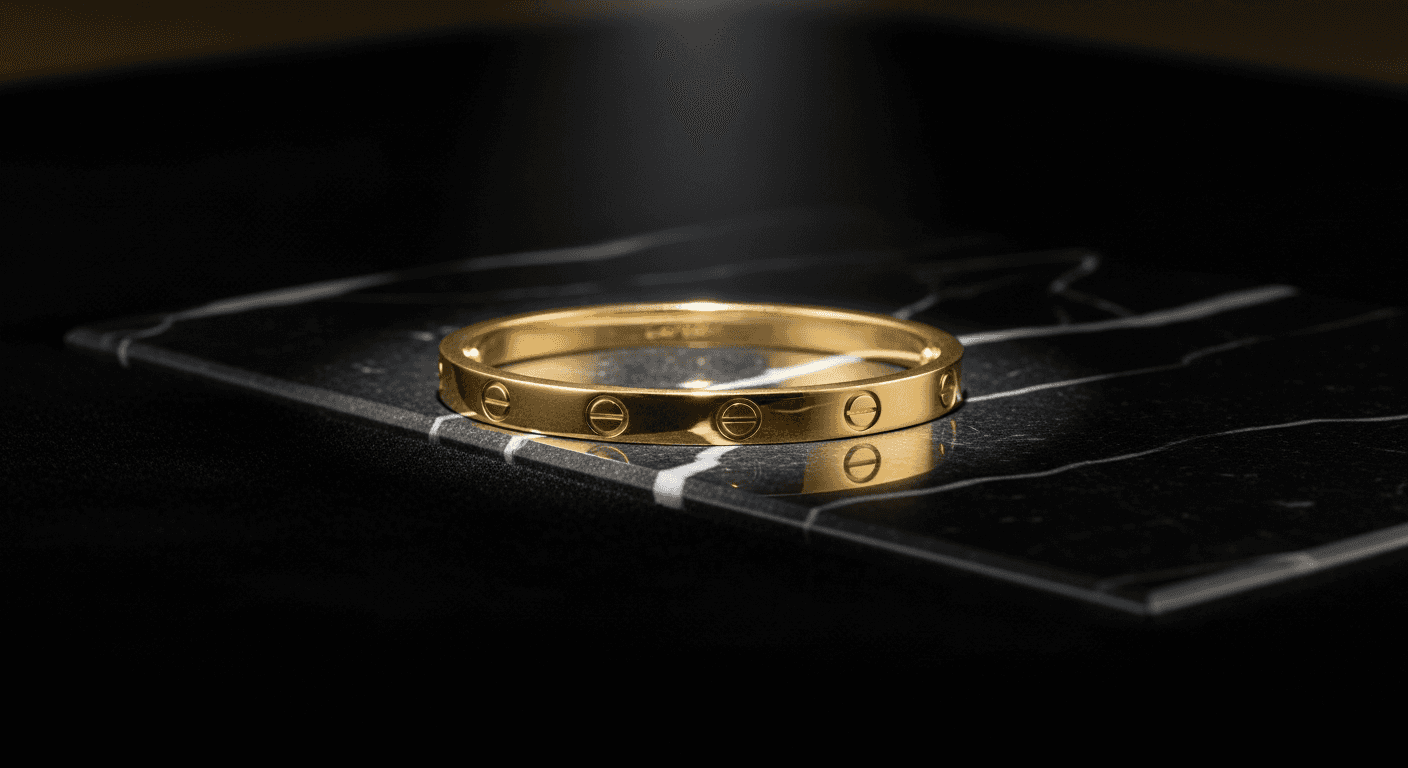
Cartier Love Bracelet: Resale Value, Authentication & Buying Guide
LuxExclusives Editorial
The Cartier Love Bracelet is the most widely faked fine jewelry piece in the world and one of the most emotionally significant. Designed by Aldo Cipullo in 1969 and unchanged in its essential form since creation, the standard classic model retails at roughly $7,950 in 18k yellow gold at current Cartier boutique pricing and trades on the secondary market at 65–95% of retail in excellent condition, depending on platform, provenance, and configuration. The investment case lives almost entirely in the rare configurations: discontinued references, full pavé diamond versions, and vintage Cipullo-era pieces. For buyers evaluating the Love as jewelry first and asset second — the honest frame — the secondary market offers 10–35% savings over retail on pieces that wear identically to new. Authentication is non-trivial, the wrong seller can cost you $6,000, and this guide walks through every decision point: retail and resale pricing by reference, the five authentication checkpoints, counterfeit tiers from $15 street copies to $3,500 Swiss-grade replicas, where to buy pre-owned safely, and how the Love compares to Juste un Clou and Trinity in the broader Cartier investment hierarchy.
For additional context on how the Love fits into a broader tangible-asset allocation, see our companion analysis Is a Birkin Bag a Better Investment Than the S&P 500? and our watches pillar coverage at The 10 Best Luxury Watches to Invest in 2026.
The Short History
The Love Bracelet was designed by Aldo Cipullo in 1969 at Cartier's New York office. Cipullo was working against the cultural current of the era — free love, bohemian sexuality, impermanence — and conceived a piece that was the opposite: two semicircular gold cuffs joined by screws, closed on the wrist with a tiny screwdriver, explicitly intended as a symbol of committed, locked love. The screws are functional, not decorative. They are real. You cannot put a Love on or take it off without the screwdriver.
Early pieces were sold exclusively to couples at the New York Cartier boutique. In 1970, the bracelet launched internationally. Cipullo later produced the related Nail (Juste un Clou) and Screw rings, but Love became the anchor and the reference point for every designer bracelet of the following 50 years.
The Current 2026 Collection
Cartier has expanded the Love line well beyond the original yellow gold cuff. Current active references include:
Bracelets
Love bracelet, small model (thin) — introduced 2016, 3.65mm wide
Love bracelet, classic/regular model — the original, 6.1mm wide
Love bracelet, SM with 6 or 10 diamonds — pavé-accented thin width
Love bracelet, full pavé diamond — entire bracelet set with pavé diamonds
Love bracelet, Paved "N" "O" "V" "E" — letter-set limited editions
Metals
18k yellow gold (the original, most common)
18k rose gold (introduced in the early 2000s, now a majority of sales)
18k white gold (introduced 1970s, softer market)
Platinum (very limited production, highest price point)
Related Pieces
Love necklace (matching motif)
Love ring (screw-motif band)
Love earrings
Love screwdriver (now sold as a collector piece separately)
Current Retail Pricing
| Reference | Metal | Retail (USD) |
|---|---|---|
| Love bracelet, SM (thin), 18k yellow gold | 18k YG | $4,950 |
| Love bracelet, SM (thin), 18k rose gold | 18k RG | $4,950 |
| Love bracelet, classic, 18k yellow gold | 18k YG | $7,950 |
| Love bracelet, classic, 18k rose gold | 18k RG | $7,950 |
| Love bracelet, classic, 18k white gold | 18k WG | $8,510 |
| Love bracelet, SM with 6 diamonds, 18k | 18k any | $9,150 |
| Love bracelet, SM with 10 diamonds, 18k | 18k any | $12,200 |
| Love bracelet, classic with 4 diamonds | 18k any | $14,000 |
| Love bracelet, classic full pavé diamond | 18k YG | $46,550 |
| Love bracelet, classic full pavé diamond | 18k WG | $49,500 |
| Love bracelet, classic full pavé diamond | 18k RG | $46,550 |
| Love bracelet, platinum (discontinued) | Pt950 | ~$17,500 last retail* |
*Platinum Love bracelets have been discontinued from current production and are available only on the secondary market.
Prices reflect current Cartier US boutique retail and are subject to change. Cartier has raised Love prices multiple times since 2022, cumulatively in the high teens to low twenties percent. Additional price increases should be expected — verify at cartier.com before any purchase decision.
Retail vs. Secondary Market: The Honest Reality
The Cartier Love Bracelet does not meaningfully appreciate on the secondary market for standard gold configurations. This is the single most important fact to understand before treating it as an investment.
| Reference | Retail | Typical Secondary Market | % of Retail |
|---|---|---|---|
| Love SM, 18k YG, excellent condition | $4,950 | $3,200–$3,950 | 65–80% |
| Love classic, 18k YG, excellent | $7,950 | $5,300–$6,400 | 67–80% |
| Love classic, 18k RG, excellent | $7,950 | $5,400–$6,500 | 68–82% |
| Love classic, 18k WG, excellent | $8,510 | $5,100–$6,200 | 60–73% |
| Love 4-diamond, classic | $14,000 | $8,600–$10,700 | 61–76% |
| Love full pavé, 18k YG | $46,550 | $32,000–$41,000 | 69–88% |
| Love full pavé, 18k WG | $49,500 | $34,000–$44,000 | 69–89% |
| Vintage Love YG (1970s–1990s) | n/a | $4,800–$14,000+ | varies by era |
| Discontinued "colored stone" refs | n/a | $8,000–$28,000+ | strong premium |
What the table shows: standard pieces trade 60–80% of retail in ordinary secondary channels, with some platforms (Rebag, The RealReal authenticated) reporting higher recovery (up to 90–95%) on in-demand references. A new buyer paying full retail still typically absorbs a 20–35% haircut the moment the piece leaves the boutique. This is comparable to most luxury watches outside of steel sports Rolex, and notably worse than Hermès Birkin economics.
Where the investment case lives:
Full pavé diamond references trade at 68–90% of retail on secondary — the highest recovery in the line because the market for pre-owned pavé is demand-constrained and diamond-heavy pieces absorb less per-gram devaluation
Discontinued configurations — certain colored stone versions (pink sapphire, blue sapphire, emerald accents) from the 2000s-2010s trade materially above their original retail
Vintage Cipullo-era pieces (1969–1974, while Cipullo remained at Cartier) in solid condition can trade at 1.5–3x their original retail, though most are impossible to precisely date without provenance; early 1970s–1980s pieces made after Cipullo's departure also command collector premiums for their age and patina
Cartier authentication cards + box + receipt add ~10–20% to secondary market price. Without the box and papers, expect the lower end of the ranges above
Authentication: The Five Things to Check
The Love Bracelet is replicated at every quality tier — $15 Canal Street copies up to $2,500 "Swiss-grade" replicas that fool inexperienced buyers. An authentication error on a $6,000 piece is a $6,000 mistake.
1. Hallmarks and Serial Number
Every authentic Love Bracelet has:
"Cartier" signature engraved cleanly in a specific serif font — the "C" has a specific curvature that replicas miss
"750" stamp (indicating 18k gold) — should be crisp, small, and properly positioned
Serial number — 6–8 alphanumeric characters on older pieces, longer format on newer
Made in France stamp on most references (some say "Made in Italy" — also authentic)
Reference number — internal Cartier code
The stamps should all be crisp. Fuzzy, shallow, or uneven stamps are a red flag. Stamps that are too deep (as if punched rather than laser-engraved on newer pieces) suggest a replica.
2. Serial Number Verification
Important policy context: Cartier no longer offers in-boutique authentication services for Love bracelets and rings (a policy shift widely reported in 2024), regardless of purchase history. Boutiques now typically decline to confirm authenticity on pieces brought in cold — they will service a piece they recognize, but formal authentication is effectively off the table. This shifts the burden entirely to third-party authentication and reputable resellers.
Reputable resellers (see "Where to Buy" below) have internal serial databases and trained gemologists who verify pre-sale. For private or uncertain purchases, third-party services like TrueFacet, Real Authentication, and Entrupy are now the primary authentication path.
Red flag: A serial number that can be looked up on any random online database. Real Cartier serials are not publicly queryable; any site claiming to "check authenticity" via a public serial lookup is not a reliable source.
3. Screws and Screwdriver Fit
Authentic Love Bracelets have a specific screw alignment pattern. The Cartier screwdriver (included with purchase) fits the screws with zero play. A replica screw will feel loose, will not seat flush, or will strip when tightened.
Red flag: The screws do not perfectly align with the outside surface when tightened. The screw heads should be exactly flush — not raised, not recessed.
4. Weight
| Reference | Authentic Weight |
|---|---|
| Love SM (thin), 18k | 20–28g depending on size (15–20cm) |
| Love classic, 18k | 30–40g depending on size (up to ~43g on the largest 20–21cm sizes) |
| Love full pavé, 18k | 40–55g depending on size |
Gold is heavy. Most replicas are gold-plated brass or silver and weigh 15–35% less than authentic. A kitchen scale accurate to 0.1g is useful.
5. Finish and Polish
Cartier's finish has a specific mirror polish on the outer surface and a softer satin on the inner surface. Replicas often get the inner/outer ratio wrong. The edges of the bracelet should be crisp — not rounded from poor finishing.
The Common Replica Tiers (Know Your Enemy)
Canal Street / Alibaba ($15–$200): Gold-plated brass. Obvious fake — weight wrong, engraving off, finish amateurish. Won't fool anyone examining the piece closely.
"Dupe" / Etsy inspired ($400–$1,500): Better quality brass or silver, sometimes gold-plated. Still identifiable to trained eye. Weight, screw fit, and serial absence give it away.
"Swiss grade" replicas ($1,800–$3,500): This is the dangerous tier. Solid 18k gold, decent engraving, passable weight. The screws and the authentication card are the most reliable tells. Professional authentication is worth the $200 fee at this price point.
"Frankenstein" pieces: Authentic Cartier shells with non-authentic replaced screws, replaced stones, or altered hallmarks. Rare but real. This is why provenance + matching serials + original box matter.
Where to Buy Pre-Owned Safely
The Love market is liquid but uneven. Our ranking of reputable sources:
Tier 1 — Professional Authentication Guaranteed
Sotheby's and Christie's jewelry auctions — authentication is warranted; you pay a buyer's premium (~25%), but the provenance is airtight
1stDibs — vetted dealer network; authentication guarantees vary by dealer but platform-level protections exist
Cartier service and Cartier Care — Cartier will inspect, service, and in many cases confirm provenance on pieces brought in by their owners; this is not a pre-owned marketplace but it is a meaningful authentication backstop on any piece you are considering
TrueFacet — specialized in luxury jewelry authentication
Tier 2 — Reputable Consignment
The RealReal — mass-market luxury; Love authentication has a mixed history but the platform accepts returns on authentication disputes
Fashionphile — primarily handbags but expanding fine jewelry; rigorous authentication process
WatchBox / Govberg — primarily watches but handle Cartier bracelets with provenance
Tier 3 — Private Dealers (Due Diligence Required)
Instagram dealer community — can offer 5–15% discounts vs. retail platforms, but buyer assumes authentication risk. Only buy from dealers with multi-year track record and willingness to provide third-party authentication pre-purchase
Local estate jewelers — occasional inventory, variable expertise
Tier 4 — Avoid Without Verification
eBay — significant replica volume; PayPal buyer protection is insufficient for this price point
Facebook Marketplace — primarily replicas and scams
Random resale websites without clear return policies
When the Love Makes Sense as an Investment
The honest answer: rarely, and only in specific configurations.
Makes sense if:
You are buying full pavé diamond (strong secondary recovery, potential mild appreciation)
You are buying a discontinued colored-stone reference from a reputable source with provenance
You are acquiring a true vintage Cipullo-era piece for historical significance (these appreciate as collectibles but are hard to value precisely)
You are buying to wear for 10+ years and view the 25% haircut as amortized across a decade of actual use
Does not make sense if:
You are buying a standard gold classic or SM with expectation of appreciation (you will likely break even at best, net of transaction costs, over 10+ years)
You are buying as a pure alternative asset (watches, Birkins, and fine art have stronger investment cases)
You are buying primarily for resale at all — the friction is too high vs. the upside
Celebrity and Cultural Status
The Love Bracelet has the strongest celebrity adjacency of any modern Cartier piece. From the original 1970s wave (Ali MacGraw, the late Nancy Reagan, the late Elizabeth Taylor receiving the late Richard Burton's gift) through contemporary wearers (Kylie Jenner, Hailey Bieber, Zendaya, Timothée Chalamet — notable men's adoption in the past 5 years), the cultural visibility is at all-time high.
This matters because the Love's value is inseparable from its symbolic position. Unlike a watch that derives value from mechanical craftsmanship, the Love derives 60%+ of its value from cultural meaning. If that meaning erodes, the secondary market follows. This is a tail risk worth naming — though we view it as low given the piece's more than 50 years of continuous cultural relevance since its 1969 debut.
Care and Maintenance
Screwdriver access: Keep the Cartier screwdriver accessible; you will need it for MRIs, surgery, and occasional removals. Lost screwdrivers can be replaced at any Cartier boutique — they are a controlled part
Cleaning: Warm water + mild dish soap + soft brush. Avoid ultrasonic cleaners on pavé pieces. Cartier boutiques offer complimentary cleaning
Screw maintenance: Screws can loosen over years of wear. Cartier will check and re-tighten free of charge. If you feel any screw movement, visit the boutique within a week — loose screws lead to stone loss on diamond pieces
Replating: White gold Love bracelets are rhodium-plated; plating wears over 3–5 years of wear. Cartier replates for a fee (~$150–$350). Yellow and rose gold do not require replating
Insurance: Schedule on homeowners/jewelry floater insurance. Document with appraisal every 3–5 years. Pavé pieces should be professionally inspected annually for prong integrity
The Curator's View
The Cartier Love Bracelet is an extraordinary piece of jewelry that is also, on a pure investment basis, merely an average alternative asset. We say this because the hype around "Cartier as investment" has become noisy enough that buyers at the boutique counter are making decisions on bad financial assumptions.
The right frame:
1. Buy the Love because you love it and will wear it for years. The secondary-market haircut is the cost of the boutique experience and of owning a new piece.
2. If you are buying primarily to invest, focus exclusively on rare configurations (full pavé, discontinued colored stones, vintage) and acquire from Tier 1 sources with airtight provenance.
3. If you are somewhere in the middle — want the Love, also want decent value recovery — buy pre-owned from Tier 1 or Tier 2 sources. You absorb only the wear delta between new and excellent-condition pre-owned, which is often only 15–25% off retail for a piece functionally indistinguishable from new.
What the Love is not: an asset that will fund your retirement. What it is: a well-made piece of cultural jewelry that holds most of its value, looks extraordinary, and carries a meaning that other high-end jewelry cannot replicate. That's enough. The investment case is secondary.
Love vs. Juste un Clou vs. Trinity: How They Compare
For buyers weighing the Love against Cartier's other iconic bracelets, this is the honest side-by-side.
| Dimension | Love Bracelet | Juste un Clou | Trinity |
|---|---|---|---|
| Designer | Aldo Cipullo, 1969 | Aldo Cipullo, 1971 (initial design c. 1970) | Louis Cartier, 1924 |
| Motif | Screw / lock | Nail (clou) | Three interlocking bands |
| Iconic width | 6.1mm classic / 3.65mm SM | 3.5mm–5mm depending on ref | Varies (narrow–wide) |
| Current retail (18k YG, entry) | $7,950 classic / $4,750 SM | $8,700 classic / $3,800 SM | $1,030 corded / $9,100 classic bangle |
| Secondary recovery | 65–80% of retail | 55–75% of retail | 45–65% of retail |
| Volatility | Low — stable 10+ yr trend | High — cycles (2018–2020, 2023 hot) | Moderate — quieter market |
| Cultural heat (2026) | Very high, sustained | Currently high, cyclical | Steady, understated |
| Authentication difficulty | High (most faked Cartier piece) | Moderate | Lower — fewer convincing replicas |
| Liquidity on secondary | Excellent — sells in days to weeks | Good — weeks to months | Moderate — weeks to months |
| Best for | Hold-value jewelry with daily wear | Fashion-forward, cycle-aware buyers | Understated layering, lower entry cost |
| Investment grade configs | Full pavé, discontinued colored-stone, vintage Cipullo | Pavé, discontinued, rose gold | Precious-stone and limited editions |
Translation: Love is the conservative allocation — higher entry cost, more reliable recovery, hardest to authenticate. Juste un Clou is the momentum play — lower entry, potentially higher returns in hot cycles, softer in quiet ones. Trinity is the entry-level allocation — accessible price, modest recovery, lower authentication risk. Most serious collectors own one of each; most first-time Cartier buyers should start with the Love.
For how these jewelry allocations fit alongside handbags and watches in a UHNW tangible-asset mix, see our handbags coverage and the watches pillar.
FAQ
Q: Can I shower/swim/sleep with the Love on?
Yes. It's designed to stay on. Daily wear is fine. Remove for heavy workouts, direct chemical exposure (chlorine/pool, saltwater extended exposure, household cleaners), or any procedure requiring metal-free skin.
Q: How do I know what size to buy?
Measure your wrist at the widest point (usually just below the wrist bone) in centimeters. Cartier sizes run 15–21cm. The Love should sit comfortably below the wrist bone with 3–5mm of play. Sizing too tight constrains movement; too loose and it flips upside down constantly.
Q: Can I get the bracelet resized?
No. Love bracelets are not resizable. If you buy the wrong size or your wrist changes (pregnancy, weight gain/loss), you must sell and buy a new size. This is a real limitation worth planning around.
Q: What if I lose the screwdriver?
Replacement screwdrivers are sold at any Cartier boutique for approximately $25–$40. They're a controlled item — you cannot order one online from Cartier directly in most markets.
Q: Is the men's Love different?
There is no separate "men's" Love — the same classic (6mm) width is unisex. In practice, men tend to prefer the classic width and white gold metal; women increasingly favor SM thin and rose gold. The sizing is the only real decision.
Q: How does the Love compare to the Cartier Juste un Clou?
Both designed by Aldo Cipullo. Juste un Clou (nail motif) has higher secondary-market volatility — it has had periods of hot demand (2018–2020, 2023) and softer cycles. Love is more stable. For pure hold-value, Love edges JUC; for aesthetic and current-cycle cultural heat, JUC is having its moment.
Kristi Caudell
Founder, Lux Exclusives
706.799.2188 | kristi@luxexclusives.com | luxexclusives.com

© 2025 Lux Exclusives All Rights Reserved