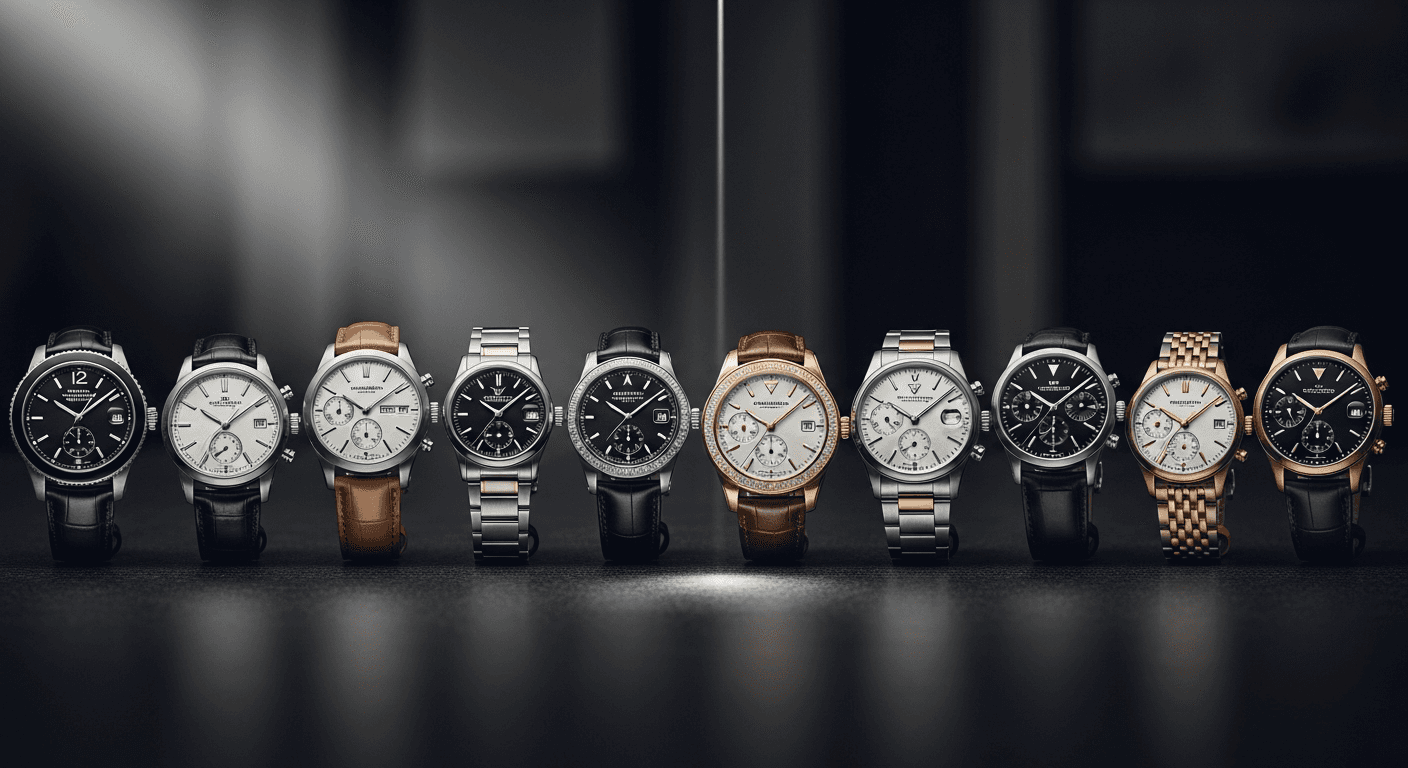
The 10 Best Luxury Watches to Invest in 2026
LuxExclusives Editorial
The luxury watch market has entered a maturation phase that separates durable stores of value from speculative casualties of the 2021-2022 bubble. Knight Frank's Luxury Investment Index shows watches delivered +140% over the past decade — outperforming the S&P 500 on a risk-adjusted basis and doing so with almost zero correlation to public markets. But aggregate category returns obscure a reality that serious collectors understand well: within any given vintage year, a handful of references drive the majority of capital appreciation, while hundreds of others trade sideways or lose value. Picking the right watch matters more than picking the right era.
The 2024-2025 correction did not damage the investment thesis — it cleaned it. Overheated references fell 30-50% from their 2022 peaks while blue-chip grail models held or modestly appreciated, reaffirming a truth that has held for fifty years: genuine scarcity, manufacturer pedigree, and cross-generational demand are the only characteristics that compound. Here are the ten watches that meet that standard in 2026, organized by investment thesis rather than price, with current secondary market data and the structural reasons each deserves allocation.
Why Watches Belong in a Diversified Portfolio
Before the picks, the allocation logic. Watches occupy a rare category: they are portable, insurable, globally liquid, wearable, and — for the right references — appreciating. Unlike real estate, they require no maintenance beyond periodic service. Unlike fine art, they can be authenticated with near-certainty by qualified specialists. Unlike wine, they do not degrade. Unlike collectible cars, they do not require storage, registration, or substantial upkeep. For UHNW investors, a well-constructed watch collection of $500K-$3M provides meaningful portfolio diversification with practical ownership utility that few other collectible categories can match.
The two non-negotiable rules for watches-as-investment: buy references with genuine scarcity (not merely "allocated"), and buy from brands with unbroken multi-generational demand. Brand matters more than complication. A simple three-hand Patek Philippe from the right reference will outperform a tourbillon from a second-tier brand ninety-nine times out of a hundred. With that frame, the list.
1. Patek Philippe Nautilus 5711/1A
The single most important discontinued reference of the modern era. Thierry Stern's 2021 decision to end production of the stainless steel Nautilus with blue dial created the scarcity event that defined the luxury watch market for the following three years. Secondary market pricing peaked above $240,000 in 2022, corrected to roughly $125,000-$140,000 through 2024, and has stabilized at $135,000-$165,000 through early 2026 — approximately 3.5-4x the original $35,000 retail price.
Investment thesis: The 5711/1A is the reference future collectors will reference when discussing 21st-century horology the way current collectors reference the 1518 and 2499. Supply is permanently fixed. Demand from first-time grail buyers entering the market at wealth-creation milestones is structural and growing. The reference functions as a blue-chip anchor for any serious watch allocation.
What to look for: 2019-2021 production with full box, papers, service documentation, and unpolished case. Examples with provenance from authorized dealers carry a meaningful premium over gray-market pieces.
2. Rolex Daytona Ref. 126500LN (Steel, Black Panda)
The current production steel Daytona remains the most universally recognized luxury watch in the world, and waitlists at authorized Rolex dealers now exceed four years in most markets. Retail is $15,100. Secondary market pricing sits at $32,000-$38,000 for unworn examples with full stickers, reflecting a durable premium that has persisted through multiple market cycles.
Investment thesis: The Daytona is the reference that every new watch collector eventually wants, which creates a perpetually renewing demand base. Rolex's tightly controlled production — estimated at 20,000-25,000 Daytona units annually across all references — ensures that steel examples will never match global demand. Unlike speculative grails, the Daytona carries minimal downside: even in the 2024 correction, prices held within 10% of peak.
What to look for: Unworn stickered examples with full set and authorized-dealer provenance. White dial ("Panda") and black dial trade at near-parity; collector preference leans slightly toward white.
3. Audemars Piguet Royal Oak "Jumbo" Ref. 16202
The 2022 relaunch of the Royal Oak Jumbo on the 50th anniversary of Gerald Genta's original 1972 design created a halo reference that has immediately achieved grail status. The stainless steel 16202ST with blue "Petite Tapisserie" dial retails at $38,400 and trades on the secondary market at $75,000-$95,000 with minimal availability. The 16202 is produced in sharply limited quantities and the waitlist at authorized dealers is effectively closed.
Investment thesis: The Royal Oak 16202 represents Audemars Piguet's explicit commitment to the original Genta design philosophy at a moment when the brand is increasingly positioning the Royal Oak line as its singular statement piece. Supply constraints are structural, not temporary. The reference's direct lineage to the 5402 "A-series" from 1972 gives it the kind of cross-generational narrative that sustains long-term valuation.
What to look for: Complete sets with the anniversary presentation box. Dial variants in yellow gold, white gold, and platinum exist at much higher price points and warrant consideration for collectors building around this reference.
4. Patek Philippe Aquanaut 5167A
The steel Aquanaut fills the Nautilus void in Patek's current lineup and now commands the same dynamics that defined the 5711 in 2018-2020. Retail is $22,970; secondary market pricing sits at $52,000-$68,000 depending on dial variant and set completeness. Waitlists at authorized dealers are multi-year and allocation is reserved for established clients.
Investment thesis: The Aquanaut inherits the Nautilus's scarcity dynamics without inheriting its peak-cycle speculative premium. Patek Philippe's production discipline — the brand produces approximately 70,000 watches annually across every reference — ensures that steel sport models will always trade at meaningful premiums to retail. The 5167A is likely to follow the 5711's trajectory over the next decade, though at a more moderate slope.
What to look for: 2020-2024 production with full box, papers, and unpolished case. The black dial is the original and most collected; the blue dial 5168G in white gold is a parallel investment-grade variant at higher price points.
5. A. Lange & Söhne Lange 1 (Ref. 191.032 or 192.032)
The Lange 1, introduced in 1994, is the most important watch produced by any German manufacturer in the modern era and the foundational reference of a brand that many connoisseurs consider the finest watchmaker in the world by craftsmanship metrics. The current production Lange 1 in pink gold or white gold retails at roughly $49,500-$54,500 and has shown steady secondary market appreciation with none of the volatility of Swiss sport models.
Investment thesis: A. Lange & Söhne produces approximately 5,500 watches annually — less than one-tenth of Patek Philippe's output. The brand's quiet, connoisseur-driven market has minimal exposure to speculative flows and deep structural demand from serious collectors. The Lange 1 is increasingly recognized as the reference that defines Lange the way the Nautilus defines Patek, and its pricing trajectory reflects that recognition.
What to look for: White gold or pink gold, complete set, ideally from 2015 or later to ensure current caliber. Platinum variants trade at significant premiums and are exceptionally rare.
6. F.P. Journe Chronomètre Souverain
François-Paul Journe produces approximately 900 watches annually, and demand from the world's most serious collectors substantially exceeds supply at every price point. The Chronomètre Souverain in rose gold with silver guilloché dial retails at roughly $58,000 and trades on the secondary market at $85,000-$120,000. The brand's recent transition of select references to platinum-only production has accelerated appreciation across the lineup.
Investment thesis: F.P. Journe is the only independent watchmaker whose work is consistently discussed alongside Patek Philippe, Vacheron Constantin, and Audemars Piguet in serious collector circles. The combination of extreme production scarcity, uncompromising craftsmanship, and the founder's singular artistic vision creates a narrative that sustains premium valuations. Early CS references have appreciated 300%+ over the past decade.
What to look for: Platinum examples with brass movement (pre-2019) are the most sought-after. Gold examples remain strong. Provenance and service documentation matter substantially given the small production runs.
7. Vacheron Constantin Overseas Ref. 4500V
The Overseas is the most undervalued piece in the luxury sport watch category. Vacheron Constantin, one of the three members of the "Holy Trinity" alongside Patek Philippe and Audemars Piguet, produces the Overseas in quantities far below its peers but trades at meaningful discounts to comparable Nautilus and Royal Oak references. The steel 4500V with blue dial retails at $24,700 and trades on the secondary market at $38,000-$46,000.
Investment thesis: The valuation gap between the Overseas and its Nautilus/Royal Oak peers is structural rather than quality-based and has compressed steadily over the past five years. As the broader market recognizes Vacheron Constantin's pedigree — the brand has produced watches continuously since 1755, longer than any other manufacturer — the Overseas is likely to continue closing that gap. The reference offers meaningful upside with substantially lower entry price than comparable grails.
What to look for: Complete sets with all three interchangeable straps (steel, rubber, leather). Blue dial is the most popular; silver and lacquered black dials are also collectible.
8. Richard Mille RM 11-03 or RM 67-02
Richard Mille occupies a category of its own. The brand produces approximately 5,500 watches per year at price points that begin at $200,000 and extend well above $1.5M. The RM 11-03 flyback chronograph and RM 67-02 extra-thin sport references are the most established investment-grade pieces in the lineup, with durable secondary market demand from UHNW collectors worldwide.
Investment thesis: Richard Mille is the only watchmaker to successfully create a new ultra-luxury category in the modern era. The brand's cultural positioning — visible on the wrists of athletes, entertainers, and UHNW figures who drive aspirational demand — creates a structural buyer base that is independent of traditional watch collector channels. Supply is extremely limited. Secondary market pricing on RM 11-03 titanium examples runs $160,000-$220,000 against a retail of $132,000.
What to look for: Any production color variant with full box, papers, and service records. Case condition matters significantly given the brand's distinctive materials. Avoid late production or heavily worn examples.
9. Omega Speedmaster Professional "Moonwatch" Ref. 310.30.42.50.01.002
The Speedmaster is the only watch worn on the surface of the moon, and NASA's continued use of the reference for flight qualification ensures its place in horological history. Current production retails at $7,000-$8,000; certain collector references from 1960s-1980s production (Cal. 321, pre-moon, specific dial variants) trade at $25,000-$150,000+ in investment-grade condition.
Investment thesis: The Speedmaster is the most culturally significant affordable watch in the market and the rare case where a reference under $10,000 retains durable investment characteristics. For collectors building entry-level positions, investment-grade vintage references with documented provenance offer meaningful appreciation potential with limited downside. Recent limited editions — particularly the Silver Snoopy, Apollo 11 commemoratives, and Cal. 321 reissues — have achieved premiums of 200-400% over retail.
What to look for: Vintage pre-moon references (pre-1970) with original dials, hands, and bezels. Modern limited editions with low production numbers and documented provenance. Avoid service-replacement dials and excessive polishing.
10. Rolex GMT-Master II "Pepsi" Ref. 126710BLRO
The steel Pepsi GMT-Master II has achieved grail status in the modern Rolex lineup and represents one of the few current-production Rolex references that reliably trades above retail on the secondary market. Retail is $11,050; secondary market pricing runs $22,000-$27,000 for unworn Jubilee bracelet examples with full set.
Investment thesis: The GMT-Master II Pepsi combines Rolex's unmatched production discipline with a genuinely iconic design that traces directly to the 1955 Ref. 6542 developed for Pan Am pilots. The steel Pepsi's multi-year waitlist at authorized dealers ensures structural secondary market demand. Historical data shows the reference appreciating steadily through multiple market cycles, making it one of the safer entry-level investment picks in the category.
What to look for: Unworn examples with Jubilee bracelet and full set from authorized-dealer provenance. The Oyster bracelet variant (126710BLRO with Oyster) is scarcer and trades at similar premiums.
What to Avoid
Three patterns have consistently destroyed capital in the watch market and should be avoided regardless of prevailing sentiment.
Over-produced "limited editions." Many brands produce "limited" editions in runs of 500-5,000 units, which is not actually limited in any meaningful sense. Genuine scarcity means sub-100 production, not marketing language.
Second-tier brands regardless of specifications. A tourbillon from a second-tier brand will consistently underperform a simple three-hand from Patek Philippe, Audemars Piguet, Vacheron Constantin, A. Lange & Söhne, or F.P. Journe. Brand pedigree drives long-term appreciation more than any individual specification.
Modified or polished cases. Original, unpolished condition with sharp bevels is a non-negotiable requirement for investment-grade examples. A polished case can reduce value by 30-50% even when the watch is otherwise complete and functional.
Authentication, Storage, and Insurance
Investment-grade watches require institutional-level handling to preserve value. Authentication should be conducted by the original manufacturer's service center or by specialists with demonstrable expertise in the specific reference. WatchCheck, Bob's Watches, Watchfinder, and the major auction houses (Phillips, Christie's, Sotheby's) provide reliable secondary market authentication.
Storage should be climate-controlled, ideally in a watch winder rotation for automatic references, with documented service intervals every 5-7 years. Insurance should be scheduled specifically (not covered under a general homeowner policy) through specialists such as Jewelers Mutual or Chubb, with current replacement-value appraisals updated every two years.
How UHNW Collectors Are Actually Allocating
The UBS Global Family Office Report 2025 shows that family offices with dedicated collectible allocations increasingly treat watches as a distinct asset class rather than a subcategory of jewelry. Allocations typically range from 5-15% of total collectible exposure, with positions weighted heavily toward established grails rather than speculative contemporary releases.
The pattern among the most sophisticated collectors is consistent: concentrated positions in fewer, better references. A collection of four to six grail-tier watches consistently outperforms a collection of twenty mid-tier examples over any multi-year horizon. Quality concentrates returns in a way that diversification within the category does not.
The luxury watch market in 2026 rewards patience and discipline. The speculative era is over; the collector era has returned. For investors prepared to acquire the right references and hold them through multiple cycles, watches remain one of the most rewarding tangible asset categories available.

© 2025 Lux Exclusives All Rights Reserved