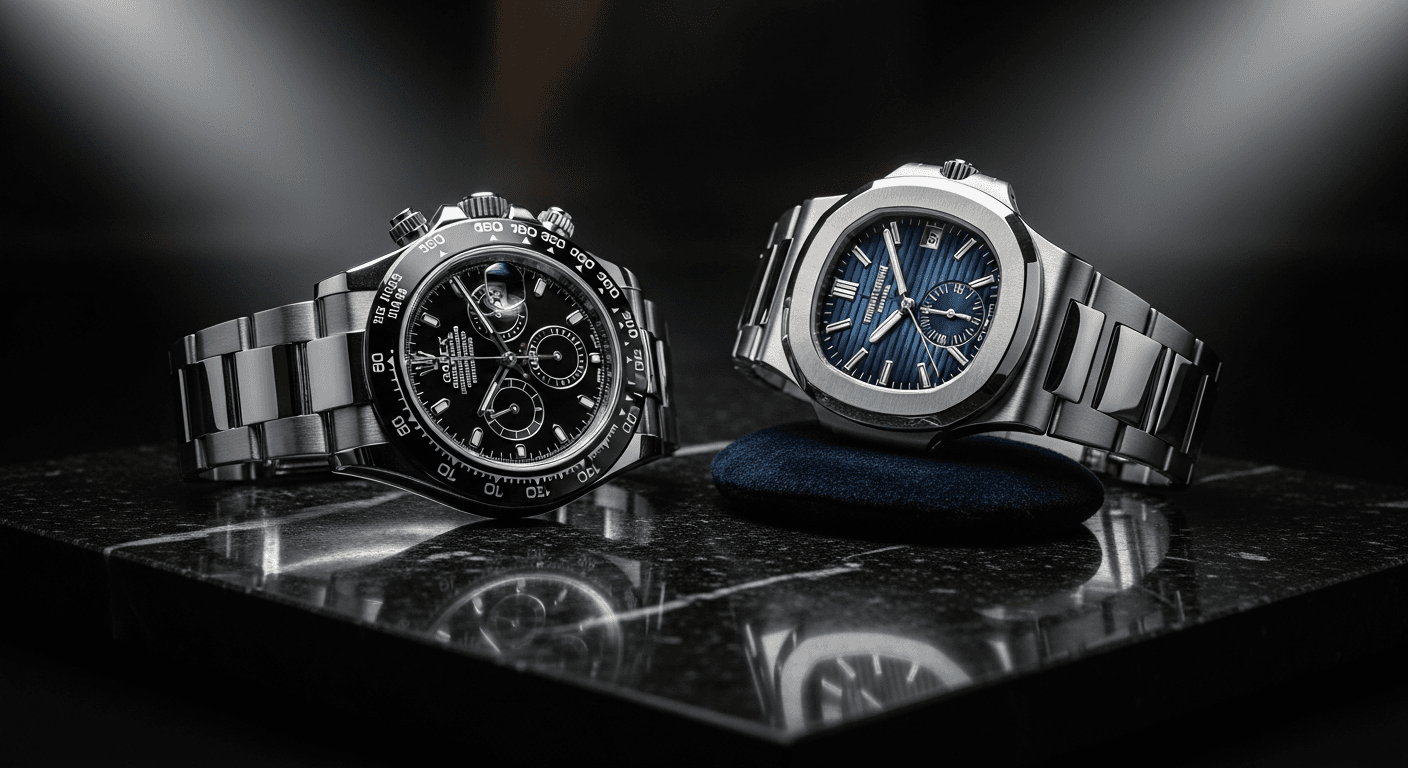
Rolex vs. Patek Philippe: Which Holds Value Better?
LuxExclusives Editorial
The two dominant brands of the high-end watch market occupy entirely different positions in a collector's portfolio. Choosing between them -- or more often, between specific references from each -- drives materially different long-term outcomes. For the UHNW investor building a tangible-asset allocation, the distinction is not a matter of taste but of portfolio mechanics: liquidity profile, volatility signature, holding period, and the relationship between retail entry and secondary market exit all diverge sharply. Understanding those divergences is the difference between owning a watch and owning an appreciating store of value.
TL;DR
Rolex produces ~1 million watches per year; Patek Philippe produces ~70,000. That 14x production gap shapes every downstream dynamic -- pricing, liquidity, volatility, and hold economics.
Rolex retail: $10K-$50K base. Patek retail: $30K-$1M+. Entry points are different markets, not different tiers of the same market.
Rolex is the most liquid luxury watch market on earth. A sports Rolex can be converted to cash globally within 48 hours. Patek is a deeper but narrower market -- fewer buyers, longer sale cycles, higher per-transaction values.
Knight Frank KFLII shows watches +140% over the decade. Patek icons drove much of that return. Rolex sports models delivered steadier, more replicable gains.
The 2021-2022 correction hit Patek's top references harder than Rolex's sports models. Nautilus 5711 fell from a $240K peak to $135-165K; Daytona 126500LN held the $32-38K range through the correction.
Rolex is the baseline allocation; Patek is the concentrated position. Most serious collectors own both -- Rolex for liquidity and capital preservation, Patek for asymmetric appreciation on scarce references.
The Scale Problem: Why Production Volume Defines Everything
Rolex manufactures approximately 1 million watches annually. Patek Philippe manufactures approximately 70,000. That single ratio -- 14 to 1 -- cascades through every other metric that matters to an investor.
High volume creates liquidity. It also creates a permanent reference price. When 200 examples of a Rolex Submariner 126610LN trade on the global secondary market in any given month, the price discovery is continuous and transparent. A seller can enter the market on Tuesday and have settled cash by Thursday. That is not hyperbole -- it is the operational reality of the Rolex secondary market, which supports specialist dealers, auction platforms like Chrono24 and WatchCharts, and a standing inventory of buyers in every major financial capital.
Low volume creates scarcity but punishes liquidity. Patek produces fewer complicated watches in a year than Rolex produces Daytonas in a week. A Patek Nautilus 5711/1A in the market is a discrete event, not a flow. Sales cycles extend from weeks to months. Auction calendars become relevant. Transaction values are higher, but the number of qualified buyers for any given piece is smaller.
This is not a flaw in either model. It is a structural feature that determines which brand belongs in which slot of a tangible-asset allocation.
Price Positioning: Different Markets, Not Different Tiers
Rolex's core catalog -- Submariner, GMT-Master II, Datejust, Daytona, Sky-Dweller -- retails between $10,000 and $50,000. The brand is positioned as the aspirational ceiling for successful professionals, accessible luxury for the global upper-middle class, and entry-level trophy hardware for collectors.
Patek Philippe's core catalog begins where Rolex's ends and extends into a different universe entirely. Basic Calatrava references retail from $30,000. Complicated references -- perpetual calendars, minute repeaters, tourbillons -- run from $150,000 to $500,000. Grand complications and unique pieces routinely clear $1 million at retail, and several million at auction.
The consequence is that the two brands serve different capital pools. A collector deploying $100,000 across Rolex can build a four-piece portfolio of sports icons. The same $100,000 in Patek might buy a single Calatrava or a used Nautilus -- concentrated exposure to one reference, one movement, one design lineage. Risk and return characteristics diverge accordingly.
Scarcity Dynamics: Waitlist vs. Allocation
Rolex manages scarcity through waitlists. Authorized dealers (ADs) maintain customer lists for high-demand sports references -- Daytona, GMT-Master II Pepsi and Batman, Submariner Hulk (discontinued), Explorer II -- with wait times that extend from 18 months to "indefinite" depending on the reference and the buyer's purchase history with the dealer. The waitlist is a marketing mechanism as much as an inventory one. It sustains the perception of scarcity that supports secondary market premiums.
Patek manages scarcity through allocation. Steel sports references -- Nautilus, Aquanaut -- are allocated to a small pool of pre-qualified clients, typically those with multi-year purchase histories and significant spending across the Patek catalog. The allocation process is opaque by design. There is no publicly stated waitlist. Access is brokered through long-term relationships with authorized retailers and, in many cases, direct dialogue with the manufacture.
The practical result: a newcomer can join a Rolex waitlist tomorrow and eventually receive a steel sports watch. A newcomer cannot access a Nautilus 5811 through retail channels at any realistic timeline. Patek allocation is functionally closed to new entrants without a prior purchase history.
For collectors entering the market today, this means Rolex is accessible at retail with patience, while Patek -- at retail -- requires either years of relationship-building or acceptance that the secondary market is the only entry point.
10-Year Appreciation: The Data
Rolex: Steady, Replicable, Category-Defining
Over the past decade, Rolex sports models have delivered steady, compounding appreciation with comparatively low volatility. The Submariner, Daytona, and GMT-Master II function as blue-chip baseline references -- the equivalent of holding S&P 500 within the watch market.
Submariner 116610LN (discontinued 2020): Retail ~$8,550 at discontinuation; secondary market currently $14,000-$17,000 depending on condition and completeness. Roughly 70-100% appreciation over five years from the 2020 retail reference point.
Daytona 116500LN (discontinued 2023): Retail $14,550 at discontinuation; secondary market currently $32,000-$38,000. More than 100% over retail, with the white-dial variant commanding the higher end.
GMT-Master II Pepsi 126710BLRO (active production): Retail $11,000; secondary $22,000-$27,000. A consistent 2x retail multiplier that has persisted through market cycles.
GMT-Master II Batman 126710BLNR (active production): Retail $11,050; secondary $18,000-$22,000. Slightly below Pepsi but with the same structural scarcity profile.
The pattern is consistent across sports Rolex: secondary market premiums over retail of 50-150%, with the premium widening on discontinued references and narrowing on actively produced ones. This is the most reliable return profile in the watch market -- not spectacular, but repeatable, liquid, and difficult to execute incorrectly.
Patek: Dominant, Asymmetric, Volatile at the Top
Patek's decade has been defined by a handful of reference-specific events that drove the brand's icons into genuinely speculative territory, followed by a correction that reset the floor but left long-term holders with substantial gains.
Nautilus 5711/1A (discontinued 2021): Retail $35,000 at discontinuation. Secondary market peak in late 2021 / early 2022: $240,000. Post-correction stable range: $135,000-$165,000. A 400%+ premium over retail persists today, and early allocation holders from 2015-2018 are sitting on 3-5x returns even after the correction.
Aquanaut 5167A (active production): Retail $23,000. Secondary $52,000-$68,000. A 2-3x retail multiplier comparable to Rolex sports, but with the added upside that Aquanaut allocation remains tighter than any Rolex sport.
Nautilus 5980/1A Chronograph (discontinued): Retail ~$61,000 at discontinuation. Secondary $150,000-$200,000.
Perpetual Calendar Chronograph 5270 (active production): Retail $195,000. Secondary $240,000-$290,000. The complication references trade at narrower premiums but have demonstrated stronger correction resilience than the steel sports models.
Calatrava 6119R (active production): Retail $40,000. Secondary $42,000-$50,000. Classical dress references trade near retail with modest premiums -- these are not appreciation vehicles, they are cultural heirloom pieces with low downside.
The Patek return profile is bimodal. Steel sports icons -- Nautilus, Aquanaut -- delivered extraordinary returns during the 2020-2022 pandemic bull market and retain substantial premiums today. Complicated references -- perpetual calendars, chronographs, minute repeaters -- appreciate more slowly but with greater stability. Classical dress watches barely appreciate at all in nominal terms but preserve capital reliably.
Aggregate Market Data
The Knight Frank Luxury Investment Index identifies watches as one of the best-performing KFLII categories over the past decade, with a +140% aggregate return. Within that figure, Patek Philippe, Rolex, and Audemars Piguet account for a disproportionate share of secondary market trading volume and price appreciation. Chrono24's price indices and the WatchCharts Overall Market Index corroborate the KFLII data -- both show roughly 2-3x appreciation on blue-chip references across a decade, with peak-to-trough volatility of 30-40% during the 2022-2023 correction.
Liquidity: The Underappreciated Variable
Liquidity is the variable most collectors underweight until they need it. The difference between Rolex and Patek on this dimension is structural and permanent.
Rolex is the most liquid luxury watch market in the world. A Submariner, GMT, or Daytona in complete condition with box and papers can be sold for full market value within 48 hours through any of a half-dozen channels: direct-to-dealer, Chrono24 consignment, eBay Authenticity Guarantee, Bob's Watches, Crown & Caliber, or private-sale network. The bid-ask spread is narrow -- typically 8-12% between what a dealer will pay and what the piece retails for at secondary. That spread is the cost of instant liquidity, and by any standard of illiquid-asset markets it is remarkably low.
Patek is a deeper but narrower market. The collector base is smaller but wealthier. A Nautilus 5711 will sell -- but it may take weeks rather than days, and the seller will likely consign through an auction house (Christie's, Phillips, Sotheby's) or a specialist dealer with a pre-qualified buyer list. Bid-ask spreads on Patek's top references run 15-25%. On complicated references, the spread can exceed 30%, because valuation requires specialist authentication and buyer pools are measured in dozens, not thousands.
This has direct portfolio implications. If a collector needs to raise $500,000 in cash within a week, a Rolex sub-portfolio can deliver that liquidity reliably. A Patek sub-portfolio of equivalent value cannot, without accepting meaningful discount pricing.
Resale Spread: Retail vs. Secondary
The spread between retail and secondary market price is the most tangible measure of brand strength and reference desirability. Current 2026 data on benchmark references:
| Reference | Brand | Retail | Secondary | Multiple |
|---|---|---|---|---|
| Daytona 126500LN | Rolex | $15,100 | $32,000-$38,000 | 2.1-2.5x |
| GMT-Master II Pepsi 126710BLRO | Rolex | $11,000 | $22,000-$27,000 | 2.0-2.5x |
| Submariner 126610LN | Rolex | $10,200 | $14,000-$16,500 | 1.4-1.6x |
| Explorer II 226570 | Rolex | $9,700 | $11,500-$13,500 | 1.2-1.4x |
| Nautilus 5711/1A | Patek | $35,000 (disc.) | $135,000-$165,000 | 3.8-4.7x |
| Aquanaut 5167A | Patek | $23,000 | $52,000-$68,000 | 2.3-3.0x |
| Nautilus 5980/1A Chrono | Patek | $61,000 (disc.) | $150,000-$200,000 | 2.5-3.3x |
| Perpetual Calendar 5270P | Patek | $195,000 | $240,000-$290,000 | 1.2-1.5x |
| Calatrava 6119R | Patek | $40,000 | $42,000-$50,000 | 1.1-1.25x |
The pattern: Rolex sports references cluster around 1.5-2.5x retail. Patek steel sports icons cluster around 2.5-4.7x retail. Patek complications and classical dress pieces trade closer to retail. The highest multiples sit on discontinued Patek steel sports watches, and the tightest liquid spreads sit on actively produced Rolex sports watches.
Volatility: The 2021-2022 Correction Lesson
The most informative stress test of the decade came during the 2021-2022 peak and the subsequent correction. Pandemic-era liquidity, crypto wealth looking for luxury outlets, and a genuine tightening of supply pushed watch prices -- particularly at the top of the market -- into speculative territory.
Patek bore the brunt of the correction at the top. The Nautilus 5711/1A peaked near $240,000 in early 2022 and corrected to a $135,000-$165,000 range by mid-2023, a peak-to-trough drawdown of roughly 35-45%. The Aquanaut 5167A corrected from peaks near $95,000 to the current $52,000-$68,000 range -- a similar order of magnitude. Patek complications held their prices substantially better, correcting 10-15% rather than 35-45%.
Rolex corrected, but less violently. The Daytona 126500LN peaked near $55,000 in early 2022 and corrected to $32,000-$38,000 -- roughly 30-35% drawdown. The Submariner corrected perhaps 20-25% from its peak. GMT-Masters held up better, with the Pepsi correcting only 15-20%.
The lesson: in a correction, Patek's concentrated-buyer-base market clears more violently than Rolex's deep-liquidity market. The upside is larger on the way up (Patek Nautilus went from $30K retail to $240K peak -- an 8x multiple). The downside is also larger on the way down. Rolex grinds more slowly in both directions.
For collectors, this translates to position sizing. A Rolex-heavy tangible-asset allocation carries lower drawdown risk but more muted upside. A Patek-heavy allocation carries higher ceiling but meaningful drawdown exposure on the sports references.
Which Rolex References Hold Value Best
Not all Rolex references are equal. The brand's sports catalog dominates appreciation; the dress and classic lines trade close to retail with modest long-term gains.
Tier 1 -- Strongest appreciation, highest liquidity:
Daytona (all stainless and two-tone references, especially 126500LN and Panda-dial variants)
GMT-Master II Pepsi (126710BLRO)
GMT-Master II Batman (126710BLNR)
Submariner Hulk (116610LV, discontinued -- now at premium)
Tier 2 -- Steady appreciation, strong liquidity:
Submariner 126610LN and 126610LV (Starbucks)
Explorer II 226570 (white dial preferred)
Sea-Dweller 126600
Yacht-Master 126622 (platinum dial)
Tier 3 -- Capital preservation, modest appreciation:
Datejust 41 (all references)
Oyster Perpetual (new 41mm turquoise and other colored dials have seen premiums)
Sky-Dweller
Explorer I 124270
Underperformers / avoid:
Cellini (discontinued, weak secondary market)
Pearlmaster (limited demand outside Asia)
Rainbow Daytona and other factory-set gemstone references -- highly volatile and vulnerable to taste shifts
Heavily modified cases or aftermarket diamond-set references -- liquidity evaporates immediately
Which Pateks Hold Value Best
Tier 1 -- Iconic scarcity, allocation-driven appreciation:
Nautilus 5711/1A (discontinued, benchmark grail)
Nautilus 5811/1G (white gold successor)
Aquanaut 5167A and 5968A (chronograph)
Nautilus 5980/1A Chronograph
Tier 2 -- Complications with strong long-term track records:
Perpetual Calendar Chronograph 5270P/G
Annual Calendar 5396 family
World Time 5230 and 5231
Travel Time references (5524, 5990)
Tier 3 -- Classical references, capital preservation:
Calatrava 6119 family
Complications 5227 (Officer's back, perpetual)
Gondolo references (for the dress-watch purist)
Underperformers / avoid:
Twenty~4 quartz references (limited collector interest)
Over-produced Calatrava references from the 1990s-2000s without complications
Any reference with service history involving non-factory parts or case polishing that compromised factory geometry
When to Choose Which: Collector Profiles
Choose Rolex-heavy if:
You need demonstrable liquidity. Estate planning, cash-flow flexibility, or shorter time horizons all favor Rolex.
You are building a first tangible-asset allocation and want proven, data-dense reference pricing.
You want geographic portability -- a Rolex is cash-equivalent in New York, London, Hong Kong, Dubai, Geneva, Singapore.
You prefer steady 50-150% appreciation to speculative upside.
Choose Patek-heavy if:
You have a five-to-ten-year minimum hold horizon and can tolerate 30-40% drawdowns without forced selling.
You have the AD relationship infrastructure to access steel sports references at retail allocation -- the single largest value delta in the watch market.
You want concentrated exposure to the most prestigious name in horology, with the understanding that liquidity will cost more when you need it.
You want complications as part of the portfolio -- perpetual calendars, minute repeaters, world time -- where Patek's craftsmanship commands a genuine premium.
Choose both if: You are building a serious tangible-asset allocation at scale. Most UHNW watch collectors run a barbell -- Rolex sports for the liquid, high-turnover portion (40-60% of watch allocation) and Patek icons plus complications for the concentrated, long-hold portion (40-60%). The diversification is real: the two brands have meaningful but imperfect correlation, and they respond to different market forces within the broader watch cycle.
Head-to-Head: Attribute Comparison
| Attribute | Rolex | Patek Philippe |
|---|---|---|
| Annual production | ~1,000,000 | ~70,000 |
| Retail entry point | $7,000-$10,000 | $23,000-$30,000 |
| Retail ceiling | ~$100,000 (rare precious metal refs) | $1,000,000+ |
| Secondary market depth | Extremely deep, global, continuous | Deep but narrow, transaction-based |
| Bid-ask spread | 8-12% | 15-30%+ |
| 10-year appreciation (sport refs) | 100-200% | 250-500% |
| 2021-2022 peak drawdown (top refs) | 20-35% | 35-45% |
| Allocation vs. retail access | Waitlist, attainable with patience | Allocation, requires relationship |
| Best in class for | Liquidity, portability, baseline allocation | Complications, icon scarcity, asymmetric upside |
| Authentication infrastructure | Well-developed, global | Specialist-required, manufacture-verified for complications |
| Collector base | Broad (global professional class) | Narrow (UHNW and serious collectors) |
What to Avoid
Regardless of brand, several categories of watch purchase reliably destroy value:
Modified cases. Aftermarket polishing that rounds the edges of a case, diamond-set bezels added outside the manufacture, or dial refinishing all destroy secondary market value. A Daytona with a polished case is worth 20-40% less than the same reference in unpolished condition.
Service histories involving non-factory parts. Especially critical on Patek complications. A Perpetual Calendar with a replacement non-factory module is a significantly impaired asset.
Over-produced references. Several Rolex Datejust variants from the 1990s and 2000s, and many unremarkable Patek Calatrava references from the same era, were produced in quantities that overwhelm collector demand. Appreciation on these pieces is minimal or negative in real terms.
Gray market at peak. Buying a Nautilus at $240,000 in early 2022 was mathematically and emotionally painful for every buyer who executed. Secondary market peaks are visible in retrospect. When a reference has tripled in 18 months, risk is high and mean reversion is probable.
Factory gemstone configurations at the edges of taste. Rainbow Daytonas, diamond-set Nautilus references, and other taste-driven precious stone configurations have dramatically different fortunes across cycles. These are fashion bets, not watch investments.
Authentication and Storage
Authentication requirements differ by brand and reference.
For Rolex: Serial number verification, movement verification by a Rolex-authorized service center or independent specialist (Bob's Watches, Watchfinder, Wempe), and visual inspection of dial, hands, case geometry, and bracelet components are sufficient for nearly all modern references. The secondary market infrastructure -- Chrono24 Authenticity Guarantee, eBay Authenticity Guarantee, dealer trade-in programs -- provides buyer protection layers that make Rolex authentication the most solved problem in the watch market.
For Patek: Complications require manufacture-level authentication. The Patek Philippe Extract from the Archives (typically 150 CHF and 6-8 weeks turnaround) certifies production details, original configuration, and historical records. For any Patek above $50,000 in value, the Extract should be obtained as part of acquisition due diligence. Minute repeaters, perpetual calendars, and tourbillons additionally warrant manufacture servicing to verify movement integrity -- this is non-optional on pieces at the $250K+ price point.
Storage for both: Climate-controlled environment (18-22°C, 45-55% relative humidity), watch winders for automatics in active rotation, bank-grade safe storage for pieces not in active wear, and comprehensive collectibles insurance (Chubb, AXA Art, PURE) covering agreed value rather than actual cash value. Insurance premiums typically run 0.3-0.7% of agreed value annually. Service intervals of 5-7 years for Rolex and 4-6 years for Patek are standard; defer service only if the watch is held in static storage and not worn.
The Institutional Context
Knight Frank's KFLII places watches among the stronger decadal performers with +140% returns, alongside rare whisky (+342%), classic cars (+185%), and fine wine (+138%). The UBS Global Family Office Report 2025 notes that 21% of family offices plan significant increases to tangible asset allocations over the next five years, with watches specifically cited as a preferred sub-category for clients seeking both portability and appreciation.
Within watches, Patek Philippe, Rolex, and Audemars Piguet account for the majority of secondary market trading volume across the major platforms. Other brands -- F.P. Journe, Richard Mille, A. Lange & Söhne -- have specialist collector followings and can deliver strong returns on the right references, but the liquidity and reference-price transparency of Rolex and Patek is unmatched. For institutional allocation purposes, these two brands are the baseline. Everything else is an overweight bet.
FAQ
Q: Between a $35,000 Rolex Daytona and a $35,000 Patek Calatrava, which is the better investment?
A: The Daytona, nearly always. A $35,000 allocation to a Rolex Daytona captures a reference with 2-2.5x retail secondary market premium, deep liquidity, and proven 10-year appreciation. A $35,000 Patek Calatrava is a beautiful dress watch but trades close to retail with modest secondary market premiums. The Patek Calatrava is a cultural purchase; the Daytona is an investment position.
Q: Is a Nautilus 5711 at $150,000 still a buy?
A: For a collector with a 10-year horizon and tolerance for 30%+ drawdowns, yes. The 5711 is discontinued, the supply is finite, and the reference is the single most recognized sports Patek in the world. For a buyer needing liquidity inside of three years or unable to tolerate further correction, probably not at that price. Timing a position at $150K that was $240K at peak requires accepting that the mean-reversion process may not be complete.
Q: Should I buy at retail or secondary?
A: Always retail if you can access it. For Rolex, joining a waitlist and waiting 2-4 years for a Daytona or GMT delivers the watch at retail, often half or less of secondary market value. For Patek, retail allocation to a Nautilus or Aquanaut is the single most valuable opportunity in the watch market -- these allocations typically deliver immediate unrealized gains of 200-400% on the day the watch is collected. Secondary is the entry point when retail access is not available, which is the norm for collectors without established AD relationships.
Q: What about Audemars Piguet and the Royal Oak?
A: Audemars Piguet is the third leg of the luxury steel sports watch trinity. The Royal Oak 15500ST and 15202ST deliver return profiles comparable to the Nautilus 5711 and Aquanaut 5167A -- strong secondary market premiums, allocation-driven scarcity, and meaningful peak-to-trough volatility. For collectors building a tangible-asset watch allocation at scale, AP complements rather than replaces Rolex and Patek. The same institutional logic applies: retail access is valuable, discontinued references command premiums, and the 2021-2022 correction hit the brand's top references similarly to Patek's.
Q: How much should watches represent of my total tangible-asset allocation?
A: Most family office frameworks recommend 20-35% of a tangible-asset sleeve for watches, within an overall tangible-asset allocation of 5-15% of total investable assets. For a $50M investable portfolio, that translates to roughly $500K-$1.8M in watches -- enough to build a meaningful 10-20 piece collection across Rolex, Patek, and selective other brands.
Q: Do vintage Rolex and Patek references outperform modern references?
A: In some cases, dramatically. Vintage Rolex Daytonas (ref. 6263, 6265, 6239 "Paul Newman" dials) and vintage Patek Nautilus (ref. 3700) have delivered extraordinary returns over 20-30 year holds. But vintage requires expert authentication, carries higher condition risk, and commands bid-ask spreads of 30-50% even at auction. Vintage is a specialist allocation, not a starting allocation. Build the modern-reference core first, then layer vintage as expertise and relationships develop.
Q: How liquid are these watches compared to other tangible assets?
A: Substantially more liquid than art, classic cars, or fine wine. Rolex sports references are functionally cash-equivalent within 48-72 hours through established channels. Patek icons take 1-4 weeks. By comparison, a blue-chip contemporary painting takes 3-12 months to sell through auction, and a classic car typically 2-6 months. Watch liquidity is one of the category's genuine structural advantages in a tangible-asset portfolio.
Q: Insurance and storage -- what should I actually do?
A: Agreed-value collectibles policy from Chubb Masterpiece, AXA Art, or PURE is the institutional default. Home storage in a TL-30 rated safe for pieces in active rotation; bank safety deposit or private vault storage (e.g., Loomis, Brinks) for the long-hold portion of the collection. Document every piece with high-resolution photography, serial numbers, and purchase documentation stored in both cloud and physical backup. Insurance premiums run 0.3-0.7% of agreed value annually and are non-negotiable for any collection above $100,000 in aggregate value.
The LuxExclusives Take
For UHNW collectors building a serious tangible-asset allocation, the Rolex vs. Patek question is not binary. The two brands serve different portfolio functions and work best in combination: Rolex as the liquid, replicable, baseline allocation; Patek as the concentrated, allocation-driven, higher-conviction position. The 14x production differential is not a flaw or a feature of either brand -- it is the structural fact that determines which belongs in which slot.
The collectors who have compounded most effectively in the watch market over the past decade are the ones who understood this. They built Rolex positions through AD relationships patiently, stored those pieces properly, held through the 2022 correction without panic selling, and used those relationships to eventually access Patek allocations that delivered the asymmetric upside. The strategy is neither glamorous nor speculative. It is disciplined tangible-asset investing applied to the most liquid and best-documented corner of the luxury watch market.
LuxExclusives helps family offices, wealth advisors, and individual UHNW clients build exactly this kind of portfolio -- authenticated, professionally valued, insured, and actively managed across watches, fine art, collectible automobiles, private aviation, luxury yachts, and off-market real estate. Every watch on our platform is documented, authenticated, and benchmarked against current secondary market data. Our advisory team works directly with collectors to source both at retail (through AD relationships) and at secondary (through our dealer and auction networks).
Explore the LuxExclusives watch portfolio to begin building or optimizing your allocation.

© 2025 Lux Exclusives All Rights Reserved