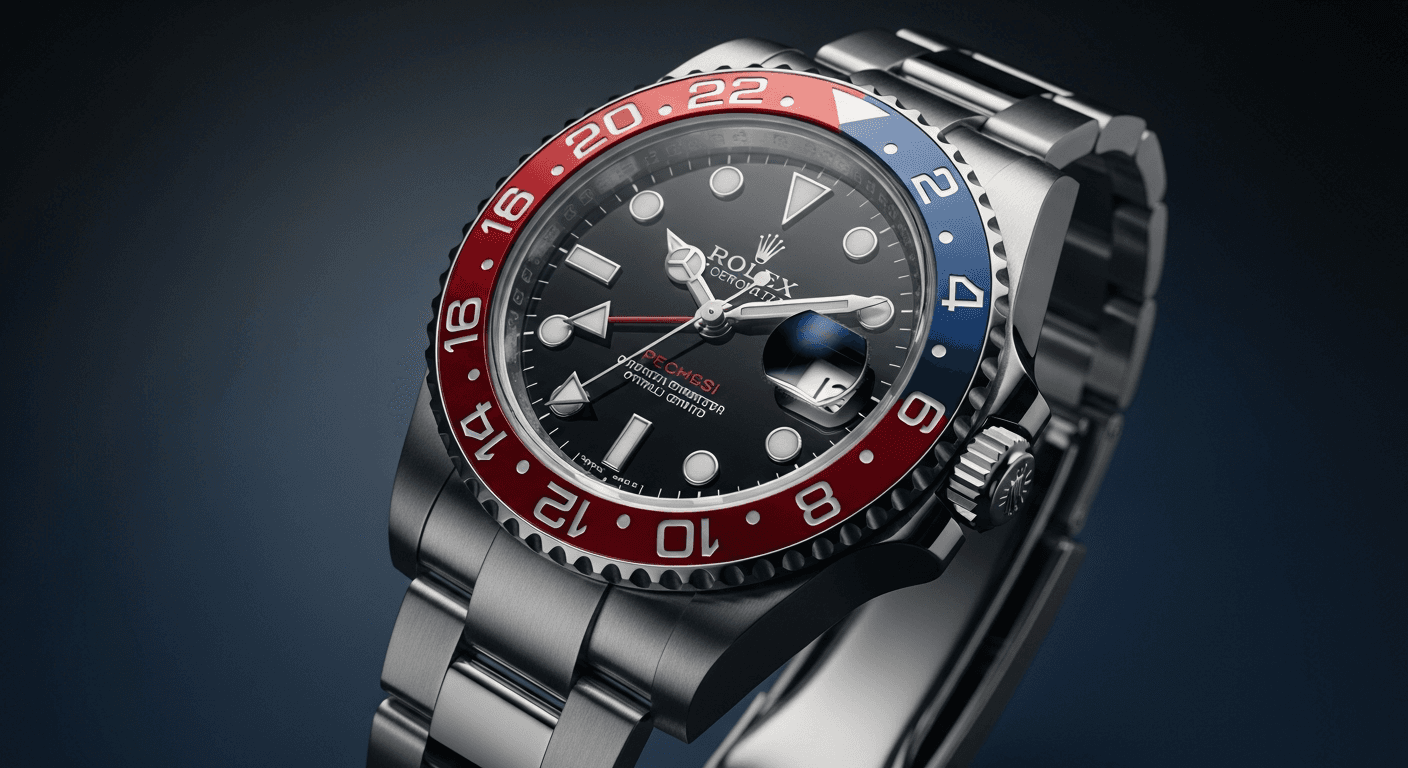
Rolex Pepsi Discontinued 2026: A Defining Shift in Modern Luxury Collectibility
Kristi Caudell
> Key Takeaways
> - Rolex GMT-Master II "Pepsi" officially discontinued at Watches and Wonders 2026
> - Both stainless steel and precious metal variants removed from the lineup
> - No replacement introduced — the scarcity is intentional
> - Secondary market already responding: inventory tightening, pricing adjusting upward
There are moments in the luxury market that do not announce themselves loudly, yet their impact is immediate and lasting. The discontinuation of the Rolex GMT Master II "Pepsi" in 2026 is one of those moments.
For decades, the Rolex Pepsi has existed as one of the most recognizable timepieces in the world. Its red and blue bezel, originally designed for Pan Am pilots navigating multiple time zones, became more than a functional detail. It evolved into a symbol of heritage, precision, and understated distinction.
Now, it has been officially discontinued.
At Watches and Wonders 2026, Rolex quietly removed the GMT Master II Pepsi from its lineup. This includes both stainless steel and precious metal variations. There has been no replacement. No reinterpretation. No successor introduced into the current collection.
For those asking whether the Rolex Pepsi is discontinued, the answer is definitive. It is no longer in production.
This shift immediately changes the position of the watch within the broader luxury watch market. The Rolex Pepsi moves from an actively produced model into a closed supply asset. That transition carries weight, not only for collectors, but for those who view tangible luxury assets as part of a more sophisticated wealth strategy.
The Rolex Pepsi has long held a unique place among Rolex sports models. It was consistently in demand, often difficult to acquire at retail, and highly visible on the secondary market. Its design is instantly recognizable, yet never overstated. It is one of the few watches that carries both cultural relevance and historical credibility without compromise.
With production now halted, its identity evolves.
The question many are now asking is whether the Rolex Pepsi will increase in value. The early indicators suggest that shift is already underway. Following the discontinuation, secondary market activity accelerated. Inventory tightened. Pricing began to adjust upward as buyers moved quickly to secure remaining availability.
This pattern is not unfamiliar.
When Rolex discontinues a model, particularly one with strong global recognition, the market typically responds in stages. Initial demand increases as awareness spreads. Supply becomes more constrained. Over time, the watch transitions from a desirable acquisition to a more selectively held collectible.
The Rolex Pepsi now enters this phase.
It joins a category of discontinued Rolex models that have historically demonstrated long term appreciation. Watches such as the Submariner Hulk and select Daytona references followed a similar trajectory, where discontinuation marked the beginning of a new lifecycle rather than the end of relevance.
What distinguishes the Rolex Pepsi is not simply its history, but the deliberate nature of its removal.
Rolex did not introduce a replacement model. There is no red bezel GMT Master II currently in production. The absence is intentional, and it creates a vacuum that heightens demand for the existing supply.
In the luxury space, what is no longer available often becomes more significant than what is.
This is where the Rolex Pepsi transitions from a watch into a collectible asset. Ownership becomes less about acquisition and more about positioning. Access shifts away from public retail channels and into private networks, curated relationships, and secondary markets where discretion and timing carry greater importance.
For collectors, this moment represents an inflection point. For investors, it signals a shift in value dynamics. For those managing broader portfolios of tangible assets, it reinforces a larger principle.
Luxury assets are not static. They evolve based on availability, narrative, and timing.
The discontinuation of the Rolex Pepsi is a clear example of this evolution. It is a reminder that value is often created not in the moment something is introduced, but in the moment it is withdrawn.
At Lux Exclusives, this is where intelligence meets ownership. Understanding when an asset transitions from accessible to scarce is not incidental. It is strategic. The Rolex GMT Master II Pepsi now exists within that framework, no longer simply as a timepiece, but as part of a larger conversation around rarity, preservation, and long term positioning.
The most compelling luxury assets are not always the newest. They are the ones that can no longer be made.
Frequently Asked Questions
Is the Rolex Pepsi discontinued?
Yes. Rolex officially removed the GMT Master II "Pepsi" from its lineup at Watches and Wonders 2026, including both the stainless steel and precious metal variants.
Will the Rolex Pepsi increase in value?
Early post-discontinuation indicators point that way. Secondary market inventory has tightened and pricing has begun adjusting upward as buyers move to secure remaining availability.
What was the Rolex Pepsi known for?
Its iconic red and blue bezel, originally designed for Pan Am pilots navigating multiple time zones. It became one of the few watches to carry both cultural recognition and horological credibility without compromise.
Did Rolex introduce a replacement?
No. There is no red-bezel GMT Master II currently in production. The absence appears intentional, creating a scarcity vacuum around the existing supply.
How does this compare to past Rolex discontinuations?
It follows the pattern set by models like the Submariner Hulk and select Daytona references — where discontinuation marked the beginning of a new lifecycle of appreciation rather than the end of relevance.
Kristi Caudell
Founder, Lux Exclusives
706.799.2188 | kristi@luxexclusives.com | luxexclusives.com

© 2025 Lux Exclusives All Rights Reserved