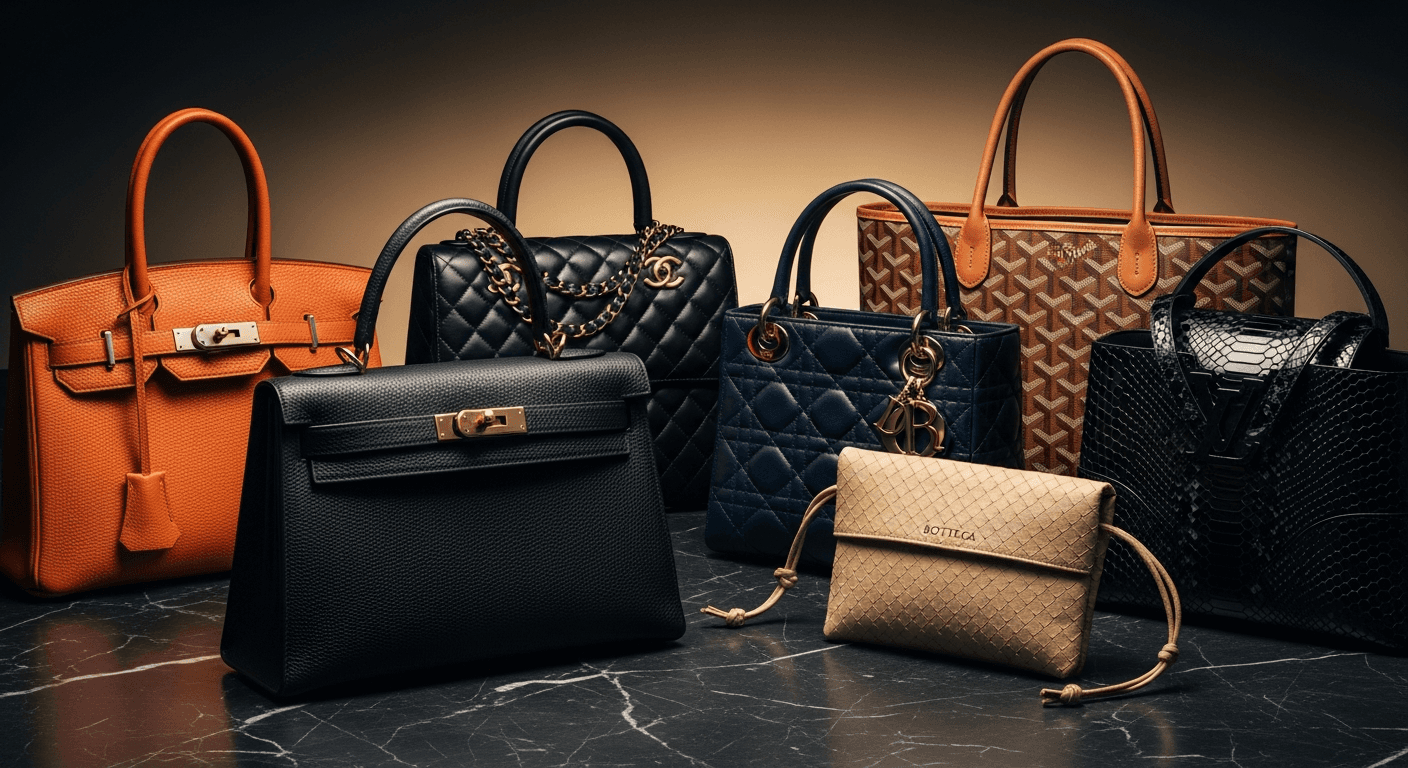
The 7 Luxury Handbags That Never Lose Value
LuxExclusives Editorial
Seven handbags currently trade on the global secondary market at or above their retail price, and the list has barely shifted in fifteen years. The Hermès Birkin retains 105–180% of retail, the Hermès Kelly 110–190%, the Chanel Classic Flap 85–140%, the Dior Lady Dior 70–95%, the Goyard Saint Louis 80–110%, the Bottega Veneta Pouch 65–90%, and the Louis Vuitton Capucines (in exotic leather only) 75–120%. Everything else — Celine, Prada, Fendi, Gucci, Saint Laurent, contemporary brands — trades at 35–60% of retail regardless of cultural moment. This is the working list we share with collectors and family offices asking which handbags to acquire as part of a diversified tangible-asset allocation. It is not a list of bags we like. It is the narrow intersection of production scarcity, brand supply discipline, stable cultural meaning, and functional collector market infrastructure — the only four conditions that reliably compound value over 5-to-10-year holds.
For broader allocation context on how handbags sit inside a UHNW tangible-asset strategy, see our companion analyses Is a Birkin Bag a Better Investment Than the S&P 500? and The 10 Best Luxury Watches to Invest in 2026.
The 2026 Retention Table
| Rank | Bag | Retail (2026) | Secondary % of Retail | 5-Yr Appreciation | Liquidity |
|------|-----|---------------|-----------------------|-------------------|-----------|
| 1 | Hermès Birkin 25 / 30 | $11,400–$70,000+ | 105–180% | +35–80% | Very high |
| 2 | Hermès Kelly 25 / 28 | $10,800–$65,000+ | 110–190% | +30–75% | Very high |
| 3 | Chanel Classic Flap (Medium / Jumbo) | $11,700–$13,400 | 85–140% | +45–95% | Very high |
| 4 | Dior Lady Dior (Medium, lambskin) | $6,700–$8,800 | 70–95% | +10–25% | High |
| 5 | Goyard Saint Louis / Anjou | $1,750–$3,400 | 80–110% | +15–40% | Moderate |
| 6 | Bottega Veneta Pouch (Small / Medium) | $3,400–$4,200 | 65–90% | +5–20% | Moderate |
| 7 | Louis Vuitton Capucines BB / MM (exotic only) | $7,500–$26,000 | 75–120% | +20–45% | Moderate |
Data reflects Q1 2026 global secondary-market comps across Fashionphile, The RealReal, Rebag, 1stDibs, Christie's, and Sotheby's Luxury sales. "Secondary % of retail" is excellent-condition pre-owned with full box and documentation. Liquidity rating estimates how quickly an investment-grade piece converts to cash through institutional channels (Very high = 1–2 weeks; High = 2–4 weeks; Moderate = 4–12 weeks).
1. Hermès Birkin (25cm and 30cm)
The Birkin is the most-studied luxury handbag in the world because it is also the most mispriced in the retail channel. Hermès does not publish handbag production figures, but widely cited analyst estimates place annual Birkin output at roughly 70,000 units, though some recent estimates are higher. For a brand at Hermès's scale of revenue, that is an extraordinarily constrained supply — and the brand's purchase-history requirement means retail allocation is reserved for established clients, creating a permanent two-tier market where secondary pricing consistently exceeds boutique pricing.
2026 retail: $11,400 (Birkin 30, Togo leather, palladium hardware) to $70,000+ (exotic leathers, special hardware, limited sizes).
Auction comps: A strong reference-level benchmark for the Himalaya Birkin 30 was set at Christie's Hong Kong in 2017 at HK$2.94 million (approximately $380,000). Himalaya Birkin pieces continue to trade in the $250,000–$450,000 range through private-dealer and auction channels. Niloticus crocodile Birkin 30s in desirable colors routinely clear $100,000–$150,000 on Fashionphile and 1stDibs. Diamond-set exotic Birkin 25 pieces have realized six-figure results at Sotheby's and Christie's Luxury Handbags sales in every recent auction cycle.
What drives value:
Size: Birkin 25 outperforms 30 outperforms 35. The smaller-size trend has been unbroken since 2018.
Leather: Exotic (Niloticus croc, Porosus croc, ostrich, lizard) drives 2.5–5x premiums. Standard leathers (Togo, Epsom, Clemence, Swift) appreciate more modestly.
Color rarity: Single-season colors in exotic leathers routinely trade at 3–5x retail.
Completeness: Box, dustbag, receipt, clochette, and cadenas all matter. Missing receipt costs 8–15%.
Our take: A Birkin 25 or 30 in Togo or Epsom in a moderately rare color is the baseline portfolio-appropriate acquisition. Himalaya or So Black if you can source and afford it. Avoid 35cm and larger in common leathers unless you are buying purely to wear.
2. Hermès Kelly (25cm and 28cm)
Often described as the Birkin's quieter sister, the Kelly actually outperforms the Birkin in certain configurations. It carries a stronger heritage arc (renamed for Grace Kelly after the 1956 Life cover), a more structured Sellier silhouette that photographs and ages exceptionally well, and the strongest appreciation curve of any Hermès reference in Asian and Middle Eastern markets since 2022.
2026 retail: $10,800 (Kelly 28 Togo Retourne) to $65,000+ (Kelly Sellier exotic, diamond hardware).
Auction comps: A Himalaya Retourne Kelly 25 set the public auction benchmark at Sotheby's Paris in September 2022 at €352,800, at the time the highest-ever public sale for a non-diamond Kelly. Standard Kelly 25 Sellier pieces in Epsom with gold hardware trade at $28,000–$42,000 on Fashionphile and Rebag consignments.
Kelly construction types:
Kelly Sellier: Structured, exposed exterior saddle stitch, more formal. Commands a premium over Retourne on the secondary market.
Kelly Retourne: Softer, inverted stitching, relaxed carry. Lower secondary premium but stronger daily-wear appeal.
What drives value:
Sellier > Retourne on secondary premium.
Kelly 25 > Kelly 28 — the smaller-size trend.
Epsom for Sellier, Togo for Retourne — each leather was engineered for the silhouette.
Shoulder strap included — detachable strap present adds 8–12%.
Our take: Kelly 25 Sellier in Epsom in Gold, Black, Etoupe, Vert Cypress, or Blue Sapphire is our single highest-conviction acquisition in the category. The appreciation curve has accelerated since 2022 as Asian demand has strengthened.
3. Chanel Classic Flap (Medium and Jumbo)
Chanel has raised the Classic Flap Medium retail from approximately $6,500 in mid-2020 to $11,700 following the most recent price increase — a roughly 80% increase over six years, executed through seven separate price hikes. Each hike resets the secondary market upward and — critically — brings boutique pricing closer to parity with pre-owned, which keeps the resale market tight.
2026 retail: $11,700 (Medium, caviar, gold hardware) to $13,400 (Jumbo, caviar, gold hardware).
Secondary comps: A Medium Classic Flap in Black caviar with gold hardware in excellent condition trades at $10,500–$13,500 on Fashionphile and Madison Avenue Couture, depending on vintage and condition. Vintage pre-2010 Medium pieces with original diamond-quilt depth — the "old Chanel" — trade at $12,000–$18,000 and have appreciated approximately 50–80% over the past five years.
What drives value:
Caviar leather > Lambskin for hold-value (lambskin scratches and loses structure).
Gold hardware > Silver/ruthenium on Medium. Silver is competitive on Jumbo.
Medium > Mini > Jumbo on current demand (Medium is the "forever" size).
Vintage pieces with deeper original quilting — quilting depth has been reduced over time, so older pieces carry a connoisseur premium.
Our take: Caviar Medium in Black with gold hardware is the single most-demanded Chanel configuration globally. It is also the most replicated — insist on full card/box/receipt and buy from Tier 1 sources only (Fashionphile, Madison Avenue Couture, 1stDibs vetted dealers).
4. Dior Lady Dior (Medium, Lambskin)
The Lady Dior is the only Dior reference that meaningfully holds value, and even then only in specific configurations. The Medium in lambskin with traditional cannage quilting has a distinct appreciation curve driven by its continuous association with Princess Diana (who carried the original in 1995) and Dior's controlled supply of the classic reference. Larger sizes, patent leather variations, and seasonal colorways trade closer to 45–60% of retail.
2026 retail: $6,700 (Small, lambskin) to $8,800 (Medium, lambskin, with strap).
Secondary comps: Excellent-condition Medium Lady Dior in Black lambskin with silver or gold hardware trades at $5,500–$7,800 on Fashionphile and The RealReal. Limited Lady Dior Art pieces (commissioned-artist editions) trade at $9,000–$22,000 depending on artist and edition size. Pre-2015 pieces with the original Dior charms and heat-stamped authenticity card are running at 20–30% premiums over current production.
What drives value:
Medium > Mini / Small / Large — the Medium is the investment size.
Lambskin with cannage quilting > patent / smooth / printed — the classic construction.
Classic Dior charms (D.I.O.R. lettered charms) — present and in good condition is non-negotiable.
Neutral colorways (Black, Latte, Navy) hold strongest.
Complete documentation — authenticity card, dustbag, box, receipt if possible.
Our take: Lady Dior is a consumer-investment crossover. For collectors building an allocation, buy one Medium in Black lambskin with gold hardware and a full set. Skip the seasonal colors and the trending mini variants — they do not retain value.
5. Goyard Saint Louis and Anjou
Goyard occupies an unusual position in the luxury handbag market: the house has historically avoided broad e-commerce, has no wholesale distribution, and operates more than 40 boutiques globally. The Saint Louis tote and Anjou reversible tote are priced well below Hermès and Chanel at retail but retain value exceptionally well because demand structurally exceeds the brand's distribution willingness.
2026 retail: $1,750 (Saint Louis PM) to $3,400 (Anjou GM, with trimmings).
Secondary comps: A Saint Louis PM in Black/Tan chevron in excellent condition trades at $1,600–$2,100 on Fashionphile and The RealReal — frequently at or above current boutique pricing once boutique supply is unavailable. Special-order Saint Louis pieces (monogrammed, custom colorways) have traded at $3,500–$8,000 through 1stDibs and private dealer networks over the past 24 months.
What drives value:
Chevron canvas pattern — the classic Goyard signature, hand-painted production process.
Color rarity — Black, Tan, and Navy are the common production colors; Red, Green, Orange, and Sky Blue are rotated in smaller runs and command 15–30% premiums.
Special order / personalization — monogrammed pieces with two or three initials carry strong dealer-network premiums.
Unlined models with minimal wear — Goyard canvas ages exceptionally well if stored properly.
Our take: Goyard is the most accessible entry into the hold-value handbag category. A Saint Louis PM in a rare color is a sub-$3,000 piece that reliably holds or modestly appreciates, making it a useful gift-grade portfolio anchor without the acquisition friction of Hermès.
6. Bottega Veneta Pouch (Small and Medium)
The Pouch, introduced under Daniel Lee in 2019, is the only contemporary Bottega Veneta reference that has held value across the brand's multiple creative leadership transitions. Matthieu Blazy's continuation of the Intrecciato weaving tradition after Lee's departure stabilized the secondary market for Pouches produced in the 2019-2021 window, while newer Bottega references (Jodie, Cassette, Hobo) have traded more cyclically.
2026 retail: $3,400 (Small Pouch, Intrecciato leather) to $4,200 (Medium Pouch).
Secondary comps: Small Pouches in 2019–2021 production in neutral colors (Fondant, Bone, Black) trade at $2,400–$3,700 on Fashionphile and The RealReal. Limited-run colorways (Parakeet green, Periwinkle, Magenta) from small production windows have sustained $3,500–$5,000 secondary pricing.
What drives value:
Small > Medium for current demand (the compact silhouette is the Pouch's identity).
Intrecciato leather > smooth or printed variants — the hand-woven construction is the brand's signature.
2019–2021 production — the original Daniel Lee era is the collector reference window.
Neutral colors for steady hold; limited colorways for appreciation upside.
Our take: The Pouch is the most brand-appropriate contemporary handbag investment. It sits below the Hermès/Chanel core tier in returns but offers genuine access at retail (no purchase-history gatekeeping) and a stable collector base. One in Fondant or Bone is a credible allocation diversifier under $4,000.
7. Louis Vuitton Capucines (BB and MM, Exotic Only)
The vast majority of Louis Vuitton secondary-market inventory trades at 40–55% of retail — Speedy, Neverfull, Alma, Pochette Métis, and nearly every monogram reference. The Capucines in exotic leather is the single exception. The more understated branding (the LV monogram is only on the closure flower), the premium construction, and LV's strategic positioning of Capucines as its Hermès-adjacent answer have created a narrow, credible investment slice within the house.
2026 retail: $7,500 (Capucines BB, Taurillon) to $26,000+ (Capucines MM, crocodile or python).
Secondary comps: Capucines BB in python in neutral colors trades at $6,500–$9,500 on Fashionphile. Crocodile Capucines MM pieces have cleared $18,000–$28,000 at Christie's Luxury auctions over the past 24 months. Standard Taurillon-leather Capucines trades at 55–70% of retail — the exotic-only discipline is critical.
What drives value:
Exotic leather only — standard Taurillon does not hold investment value.
Python and crocodile are the strongest; ostrich is moderate.
BB > MM for current demand.
Ruthenium or gold hardware holds better than silver-tone.
Neutral colors (Black, Noir, Magnolia, Galet) outperform seasonal colors.
Our take: Capucines BB in python or crocodile in a neutral color is the most Hermès-competitive bag any non-Hermès house produces. If you want portfolio value retention from a non-Hermès maison, this is the acquisition. Skip non-exotic Capucines entirely for investment purposes.
What NOT to Buy as Investment
The bags below are credible consumer goods and in many cases beautiful objects, but they do not retain value on the secondary market. They trade at 35–55% of retail regardless of cultural moment:
Celine Triomphe / Luggage — oscillates with fashion cycles under each creative director.
Fendi Baguette / Peekaboo — the 2022 Baguette revival has already peaked.
Gucci Jackie / Horsebit 1955 — consumer-heavy demand, weak collector infrastructure.
Saint Laurent Loulou / Sac de Jour — retail-adjacent trading throughout.
Prada Galleria / Re-Edition nylons — viral-cycle bags that return to earth.
Louis Vuitton monogram canvas (non-exotic) — abundant secondary supply.
Contemporary brands (Polène, Staud, Khaite, Jacquemus) — no long-dated secondary market.
If you love them, buy them. If you are buying them to resell or hold value, don't.
Care and Storage That Preserves Value
The single biggest avoidable value destruction in luxury handbags is improper storage.
Stuffed, not flat. Store bags stuffed with acid-free tissue or dedicated bag pillows. Never folded or empty — structure collapses and permanent creases form.
Dustbag always. Keep the original for resale value. Replace with museum-grade cotton if the original is damaged.
Humidity 45–55%. Too dry cracks leather; too humid allows mold. A $25 hygrometer is worth it.
Temperature 60–70°F. Attics, basements, and garages are death for leather.
Out of direct sunlight. UV fades dye permanently and the damage is irreversible.
Rotate wear. Daily carry of any bag for 90 consecutive days accelerates wear patterns visible to authenticators. Rotate among pieces.
Handle oil is real. Wash hands before carrying. Do not apply hand lotion immediately before handling.
Annual professional clean for caviar and exotic leathers. $75–$250 per piece depending on scope.
Where to Buy and Sell Safely
For acquisition:
Boutique direct (requires Hermès purchase history).
Sotheby's and Christie's Luxury Handbags & Accessories auctions.
1stDibs (vetted dealer network).
Madison Avenue, Rodeo Drive, Ginza specialty dealers with 10+ year reputations.
Fashionphile, Rebag, and The RealReal for authenticated consignments.
For consignment:
Fashionphile (strongest authentication — commission is 30% on the first $3,000 of the sale price and 15% on the portion above $3,000).
Madison Avenue Couture (high-end private clients).
Sotheby's or Christie's (for rare/exotic pieces at $30K+).
The RealReal (mass market, lower commission, higher volume).
Avoid:
eBay for pieces above $2,000 retail.
Facebook Marketplace and peer-to-peer Instagram resellers without documented track records.
Private DMs for any piece above $5,000 without independent third-party authentication.
Tax and Insurance
Luxury handbags are classified as collectibles under U.S. IRS rules. Long-term capital gains (held over one year) are taxed at a maximum federal rate of 28% — higher than the 20% maximum on most other long-term capital assets. Short-term gains are taxed at ordinary income rates up to 37% federal. Schedule each piece above $5,000 retail on a homeowners floater or a dedicated valuable personal property policy; annual insurance cost typically runs 0.3–0.8% of declared value. Update appraisals every three to five years.
For UHNW collectors, charitable donation of appreciated pieces to qualified organizations allows a fair-market-value deduction without recognizing capital gains — a useful tool for collections that have appreciated substantially.
The Curator's View
The list above has been remarkably stable through three cycles over the past decade: heated pre-pandemic (2018–2020), pandemic-driven explosive returns (2020–2022), and the more rational, selective environment since 2023. The bags that held value in 2015 are the bags holding value in 2026, with minor internal ranking shifts. Hermès still takes two of the top three slots. Chanel's Classic Flap is still the third. The tier below — Dior, Goyard, Bottega, Capucines — rotates with brand discipline and creative direction but collectively represents the outer boundary of the investable universe.
Luxury handbags are a credible alternative asset class at the top of the market. Below that threshold, they are beautiful consumer goods that retain value better than most luxury purchases but do not compound wealth. Treating them as the latter when they are actually the former is the most common mistake new collectors make. Build a portfolio, not a wardrobe.
Frequently Asked Questions
Q: If I can buy only one "investment" bag, where do I start?
Hermès Kelly 25 Sellier in Epsom, Black or Gold with palladium hardware. Budget $22,000–$32,000 for excellent condition. It has the strongest appreciation trajectory, deepest buyer pool, and most liquid secondary market of any single handbag on this list.
Q: Is now a good time to buy?
The current environment is selective rather than speculative. Hermès boutique pricing continues to rise, which reinforces secondary pricing. Chanel secondary softened slightly post-2022 price hikes as buyers absorbed the increases, but has stabilized. Nothing is on sale, but nothing is in a bubble either.
Q: How long should I hold to see meaningful appreciation?
Minimum five years for secondary-market appreciation above transaction costs. Ten-plus years for meaningful compounding returns. These are not trading instruments — holding periods matter.
Q: What about exotic leather bans?
Crocodile, python, ostrich, and lizard remain legal in most markets with CITES documentation. California, the UK, and parts of the EU have tightened exotic leather import rules — check your jurisdiction before purchasing if you plan to travel or relocate with the piece. Hermès includes CITES documentation with exotic pieces.
Q: Do I need to insure my handbags?
Yes. Schedule each piece above $5,000 retail on your homeowners floater or a dedicated valuable personal property policy. Annual cost runs 0.3–0.8% of declared value. Refresh appraisals every three to five years.
Q: What bags are on the watch list that might join this list in the future?
Hermès Oxer (2023 launch, tightly constrained production), Hermès Della Cavalleria (production recently restarted), specific Chanel 19 and Coco Handle configurations. None yet have the five-plus-year track record to justify inclusion, but we monitor them.
Q: Are pre-loved LV Neverfull or Speedy viable entry-level investments?
No. They are consumer goods. Neverfull trades at 55–70% of retail for popular configurations — a respectable consumer outcome, not an investment return.
Q: How do I know if a piece is overpriced on the secondary market?
Cross-reference at least three sources: Fashionphile "just sold" data, The RealReal recent sales, and 1stDibs asking prices. If a piece sits more than 15% above the midpoint of those three without a clear scarcity reason (exotic leather, rare color, discontinued reference), walk away.
Q: What are the tax implications of buying and selling luxury handbags?
In the U.S., long-term capital gains on collectibles are taxed at a maximum federal rate of 28% — higher than the 20% maximum on most other long-term capital assets. Short-term gains are taxed at ordinary income rates up to 37%. Consult qualified tax counsel; the rate differential matters materially at higher transaction volumes.
Q: What is the best way to start a handbag investment allocation from zero?
Three-piece core: Chanel Classic Flap Medium in Black caviar with gold hardware ($11,700–$13,500), Goyard Saint Louis PM in a rare color ($2,000–$3,500), and — if you can access Hermès — a Kelly 25 Sellier or Birkin 25 in Epsom or Togo ($22,000–$32,000). Total allocation $35,000–$49,000. That three-piece portfolio covers the three tiers of the retention universe and establishes purchase history at Hermès for future acquisitions.
Kristi Caudell
Founder, Lux Exclusives
706.799.2188 | kristi@luxexclusives.com | luxexclusives.com

© 2025 Lux Exclusives All Rights Reserved